Introduction
There are a lot of new things that I wanted to share with you all but, I'm not having personal free time enough lately. I really wanted to go for an individual pedal by pedal complete review but, I'm running out of time lately so, I had some time to do an overall review of my current rig, which includes all the new incomes.
In that way, instead on focus on every little detail related to every pedal, I can describe why I've choose these and, what I am trying to achieve with the complete rig.
After a bunch of years chasing my tone, I think I've reached the end of the search, with a very satisfactory gear. Unfortunately, there is only one true in Audio: you got what you paid. Audio is expensive as hell but, most of time I regret of spending lot of little money in cheap pedals that never satisfied me. But, even going for the expensive stuff, it's really difficult to get what you really need and, what you need depends only on your own.
The gear I'm introducing here was selected to suit my personal needs. If you have similar needs, this can be a good opportunity to plan your next acquisitions. If you don't have similar needs, to know how each pedal sounds can help you to definitively discard them.
Amp
The amp is a Fender '59 Bassman LTD. I've substituted the stock GT tubes with a set of tubes from Watford Valves, which I find that sound better.
Current production Jensen' speakers lack the magic that original ones had. I am always finding that new Jensen sound really nice alone but, they are lost in the mix, as soon as you play in a band context or with backing tracks.
I wanted to swap the four P10R speakers with four Celestion Gold but, unfortunately, the amp's chassis perfectly fits the carved rectangular shape of the Jensen's cone and, therefore, the round cone of the Celestions doesn't work there. So, I finally ended with a couple of Celestion Gold at the bottom of the cab and, a pair of P10R above.
After trying several amps, of any kind, what I've decided is to go for an amp with exceptional cleans that can take any pedal with ease and that don't mask my guitar's foundational tone.
The Bassman has some magic in its simplicity. Remember that the first Marshall (JMP 45) was based in a Bassman and, that both are mythical because of their tone.
The Bassman gives me one of the best Fender's clean tones and, it's so kind that takes any pedal with ease. This makes it a good platform to build any wanted sound with the help of some pedals.
But, it's an amp that needs some time to get what you wanted.
The normal channel is somewhat fat and a bit blurred, while the Bright channel is excesivelly bright.
I'm using it with both channels linked and, with the volume of bright channel more or less at 3, and the normal channel more or less at 1.
After tweaking a lot its controls, I find that the control that better definition gives to the sound is the Presence control so, I am setting it barelly to max.
For a balanced tone, tone controls (middle, treble and bass) work better for me around 7.
It took me a long while until I went to this recipe!.
Each amp has its sweet spots and, I find the Bassman is perfect with these settings.
Guitar
I've already introduced my new number 1 in previous entries.
My preferred guitar, now, it's my make-to-order custom Southern Belle Guitars Strato.
I've ordered the guitar to satisfy my requirements. I wanted the sound of a pure Strato but, with all the little details that can improve the original model and, it worthed the money!.
If you want to know more about it, just read the previous entry in this blog.
Cables and Patch Cords
I've already discussed about this in previous entries but, not a bad idea to remember it.
I'm using Eminence Audio' stuff, only.
Sound quality is top notch and, they have a for-life-warranty. That means that if your cable breaks, they send to you a brand new cable. So you expend the money just once. And, it works like this (it happened to me)!!!.
For guitar-to-pedalboard or pedalboard-to-amp, I'm using their The Forte MKII.
For Patch cords, I'm using their Monorail, with SIS plugs (very easy to make your own cords!).
Pedalboard
The pedalboard has evolved year by year. I think what I've got right now is the best combination I've ever had and, perfectly combines with my preferred guitar and amp.
Tuner - Peterson Classic Stomp
Not too much to say about the tuner. It's just the most accurated and, it has the possibility to use it as a DI box for Studio Recording.
Wah - Roger Mayer Vision Wah
Not my preferred Wah. I find its rocker's range as a bit short to my taste.
Soundwise, it's a great sounding wah and, highly tweakable.
You can select between 16 different wah voices, you can fine-tune the Q-Filter for each one and, you even have a booster or gain control.
But, what I really like about this wah is that is really quiet, compared to most of Wahs, which tend to introduce floor noise and which tend to introduce unwanted feedback. The RM's is one of the quietests of the market.
Vibe - Dry Bell Machine
My preferred all-the-times Vibe.
It has every original feature and, the original sound and, it goes beyond the original.
It's one of the best vibe sounds of the market and, it offers something that no others offer: a very friendly pedalboard size (except the Lovepedal Pickle Vibe, which doesn't sound as good).
It's easy to control, nice sounding and small enough.
This is a keeper for life.
Buffer / Enhancer - Klon KTR
Well, you know. There is so much hype with the Klon Centaur that, I had to check a Klon pedal.
Honestly, the prices of Centaurs are ridiculous high and, I cannot pay such a money for a single pedal.
But, Ok, I went to the web of his creator and, read about the KTR. According to his creator, he spent lot of years trying massive production components to achieve the same sound with the KTR as the original Centaur units.
Well, I cannot talk about this, because I hadn't the oportunity to check the three pedals in a row so, I can only opine about what the KTR does and, how it fits my needs.
I don't like the KTR used as an Overdrive. Reason is that it introduces a very fat distortion grain, somewhat confussing and compressed, at least with middle amp's volume. Maybe it can make wonderful things with the amp really kranked but, I don't like that way.
In the other side, with the gain at 0, it's an awesome buffer and, helps you to round the sound, making it nicer but, without affecting your instrument's foundational tone.
It remembers me the combination of a Xotic EP Booster and a buffer or, the Wampler's Decibel+.
But, differently to both, the KTR has a tone control that helps to remove excesive highs and, to better round the final result. Used this way, I complete love this pedal and, it's on all the way, being part of my clean foundational tone.
The KTR has a switchable output buffer, which honestly works better switched on. This helps to feed the rest of the chain.
Compressor - Bogner Harlow
This pedal will be loaded out of my pedalboard. It's a mix of overdrive and compressor but, the bad side of all this is that you cannot control each effect separately, which is a mess.
As you add compression with the Bloom control, you are also adding what they called 'grit' but, if you go beyond 12 o'clock in the bloom control, the pedal introduces a very dirty, fat grain distortion that I don't like. Maybe, as in the case of the KTR, this could sound awesome in a really kranked amp but, it doesn't work fine in my case.
I'm planning to load in back the Wampler's EGO, which is an awesome compressor.
Overdrive 1 - Lovepedal Kalamazoo
I wanted to thank you to Rafa, by Auvisa, to introduce me to this pedal.
It's an awesome overdrive, super-versatile.
I think this pedal is on the line of the kind of pedals introduced by Mad Professor, with his Sweet Honey Overdrive. So, this is a warm pedal, with a very bluesy core.
Appart of Gain and Volume, if you play with Tone and Glass controls, you can achieve a wide range of overdrive tones.
It can go really dark and compressed, remembering me most of the Dumble-alike pedals (as the Hermida Audio Zendrive or Weehbo Dumbledore) or, it can go very clean Tweed, as most of Bassman-alike pedals (Wamplers '59 Tweed, etc).
Some people says that it can nails the better tones of a Centaur.
I don't think so, honestly, because what I like from the KTR is the clean tone and, what I love from the Kalamazoo is just the dirty tone.
The pedal alone is gorgeous sounding but, stacked into the Bogner Wessex is pure Hard Rock Heaven.
Overdrive 2 - Bogner Wessex
If the Kalamazoo is needed for bluesy old-school tones, the Wessex is needed for old-school crunchy tones. It's a very marshallish pedal, very crunchy.
The Kalamazoo into the Wessex produces an incredible nice old-school Hard Rock tone that I love.
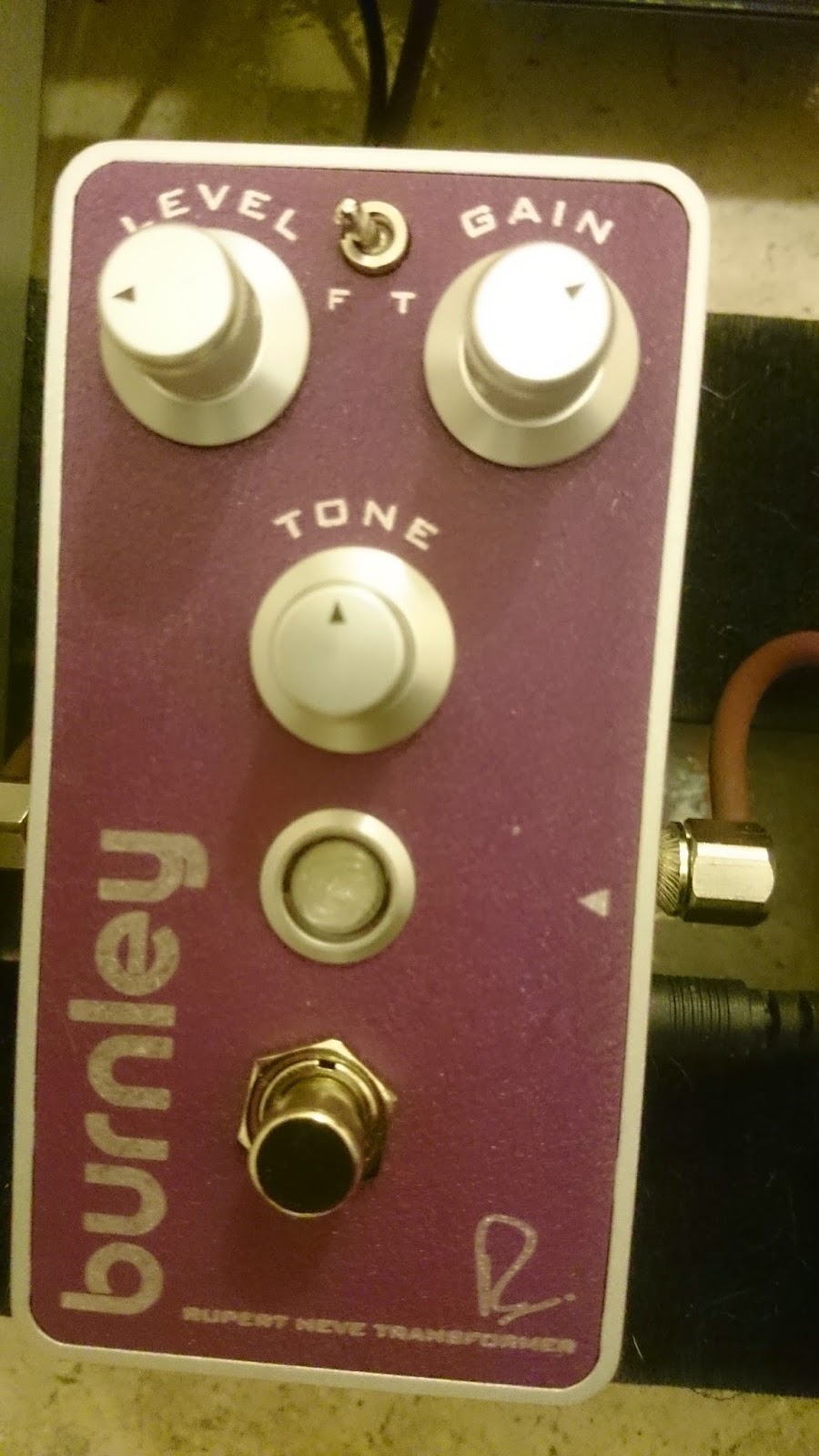
The Wessex into the Bogner Burnley creates a Marshallish wall of sound, real hi gain tone.
Alone, has its own use but, I love it combined more combined with other pedals.
Hi Gain - Bogner Burnley
It's similar to the Shur Riot in any single sense, even the color but, the Burnley has a more refinated sound to my taste, with a very musical feedback, specially when pushed by some other pedal behind it.
As I've explained in other entries, Bogner's pedals have an OT designed by Neve, which make a great difference in sound and feel. They realy feel like an amp, in the way that the sound manifestates itself.
I've tested really good pedals, as the Wampler's, Mesa Boogie's or the Weehbo's and, all them were sounding awesome, until I've heard and played the Bogner's. End of story.
Volume Pedal - Boss
Well, to be honest, I even don't remember the exact model. It's just a passive volume control pedal.
I'm using it after the gain section to control the overall loudness, once the original sound was already processed by the gain pedals.
I want it to match the loudness to the backing tracks o to the particular sound I'm working at a time.
Of course, it can be used for sweelings but, not my case.
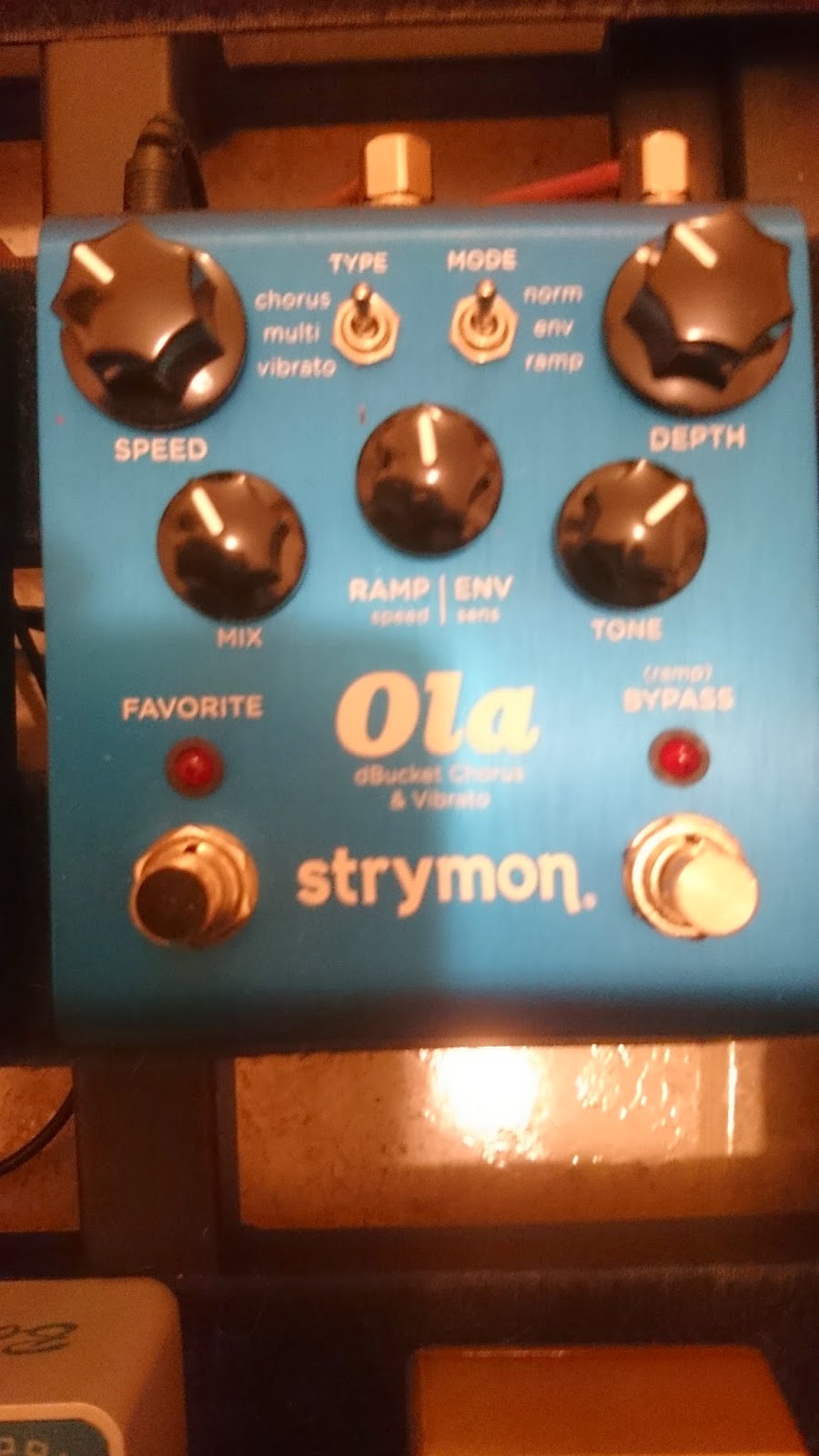
Chorus - Strymon Ola
I really need a Chorus in very few songs. The Strymon has a studio quality in all their pedals and, this one isn't different. I'm using a fixed chorus mode, very wide and clean sounding. Nothing special, but really nice.
Reverb - Strymon Bluesky
There are a couple of my amps that doesn't have a built reverb effect and, unfortunatelly, the Bassman is one of them.
I'm running the typical Springs Reverb mode in the Bluesky and, it helps me (together with the delay) to put my guitar in the right depth of the mix.
Delay - Strymon El Capistan
A great sounding Tape Echo pedal. I'm using just a fixed setting and, together with the Strymon Bluesky, its used to put my sound in the right depth of the mix.
The Bluesky, the El Capistan and the KTR are part of my foundational clean sound.
I'm sculpting the rest of sounds over those three pedals, which are active all the time.
Video
This video has two parts.
The first part, I'm talking about my rig and sharing with you same comments you can read above so, you can skip that part, in any case.
Second part, I'm demoing the sounds of the rig, in clean and then, by adding some other pedals. Probably, the most interesting part for you, if you've read what I write above.

Everything about electric guitars world
Showing posts with label Guitars. Show all posts
Showing posts with label Guitars. Show all posts
06 June 2015

17 March 2015
My custom Southern Belle Guitars' Strato is here!
Introduction
One day many months ago, I was viewing some demo video about a new set of pickups that David Allen was releasing. Such pickups were mounted in a guitar that sounded really killer. It was a Southern Belle Guitars' Cabronita (Tele).
Just discussing about it with David, He said me that those guitars were fantastic and, that He wanted to buy a couple for his store and, asked me I was interested on having a guitar from them. Well, some days after, He introduced me to Morgan Mitcham, who runs Southern Belle Guitars. I justed wanted to know if She could make some kind of hot rodded Strato to my specifications and, since She had no issues, we had an agreement.
If it's difficult to see a woman playing electric guitars, it's even more difficult to know a woman that works building guitars !!!. That made the decision even more interesting to me.
4 or 5 months since I've ordered Her, 1 more month in Customs clearing and, half month for the final setup. Was a looooong waiting time and, when her finally came home I had a mix of feelings: exciting because her was here and, worried... would her sound that good?, worthed her the time and money?. I made some risky decision, would her be comfortable?.
My specifications
I wanted the following:
What I wanted is to preserve the good things of a Fender Deluxe Strato and, to fix the things that I don't like so much.
By example, the soft-V neck provides just the right amount of extra wood, compared to a modern C-shaped neck, to add body and resonance to the instrument.
The beveling of the neck pocket of the Deluxe is of help but, not enough to my taste.
I don't like the LRS nut, because I find it as adding to much hi end, and giving a very metallic touch to the sound.
I don't like the micro-tilt system, because it creates a dumb area around frets 14-17 and, strings 2 to 5, that kill the sustain of the notes. The carved area and that metallic mechanism kills the overall sustain and, very specially affects to mentioned frets.
I find that a good bone nut makes the attack more snappy, something I like.
Maybe the color cannot be a key decision respect of sound, but I never liked any of the colors that Fender released for Deluxe Stratos and, I particularly love that Cherry Burst.
David Allen was going to provide a set of Furys (think on Robin Thrower) for this axe but, maybe we didn't clarified this point to Morgan so, the axe came with a set of Dovers (which are one of the best sets of DA Pickups).
Opening the box
 The guitar came with neck and body separated. This is an overall look of the neck and fretboard. The fretwork was perfect (well leveled, sanded and crowned). The touch of the satinated nitro was really good, as suggested by Morgan.
 A detail of the nut and peghead. Morgan decide to make the nut of Tusq, since She considers that Stratos sound better with such a material. I still want to check the sound with a bone nut. Maybe, I will come back to tusq, who knows it!.
 And, this is an overall view of the body. That Cherry Burst looked killer, among the rest of components.

And, here a detail of the special shape of the neck pocket and area around, which allows a better access to low frets.
Testing sound and feeling
The guitar plays like a dream and, the sound is perfect. Her has a nice resonance, body and sustain and, bell-like sounds that are a pleasure. Compared with an Eric Johnson model I've tested in a Store, is maybe 3 steps over and, compared to the moded Deluxes I and my friend own, is a couple of steps over.
One of the things that firstly called my attention was her weight. She is surprisingly lighter than any other Strato I've ever tested. Maybe the wood has more open cells, I dunno.
Since I was experimenting D'Addario NYXL1046 strings for a couple of months in my Deluxe, and loved the results, that's the set of strings I've mounted in this axe, as well. I find this NY series as having more tuning stability and, third and second strings seem more consistently sounding.
I wanted that my fellow friend Robert Tirado make the demo of this axe, because this man has a magical touch that can get everything from an axe and, this axe owe it. I was just hearing the guitar, which is a more objective way of analyzing the sound.
My other fellow friend, Alex Tirado, brother of the former one, was the luthier doing the final setup, before the demo / test. I wanted to make the test with my regular gig.
Robert went first demoing the typical five strato positions, from neck to bridge, in clean.
After we heard really excited all the bells, we wanted to see if the guitar was able to aggressively roar and, we tested it with a high gain configuration. Total craziness!. The sound was hitting hard our guts and, there was a really nice feedback effect; not uncontrolled whistles but, a really nice feedback effect.
Finally, Robert improvised over some backing tracks. The video has just two of the many that were played that day.
After I was fully satisfied with what I've heard, it was my time but, nothing was recorded then. This will be my #1 from now so, any new video will be made with this axe (if a Strato is involved).
This is the video...
And the Gear...
The amp is a Fender '59 Bassman LTD, with a retrofitting set from Watford Valves, that includes a couple of NOS JAN/Philips 6L6 (well, in fact, they are 5881) tubes. The two lower stock Jensen P10R speakers where swapped with a couple of Celestion Gold. Here you are the settings:




One day many months ago, I was viewing some demo video about a new set of pickups that David Allen was releasing. Such pickups were mounted in a guitar that sounded really killer. It was a Southern Belle Guitars' Cabronita (Tele).
Just discussing about it with David, He said me that those guitars were fantastic and, that He wanted to buy a couple for his store and, asked me I was interested on having a guitar from them. Well, some days after, He introduced me to Morgan Mitcham, who runs Southern Belle Guitars. I justed wanted to know if She could make some kind of hot rodded Strato to my specifications and, since She had no issues, we had an agreement.
If it's difficult to see a woman playing electric guitars, it's even more difficult to know a woman that works building guitars !!!. That made the decision even more interesting to me.
4 or 5 months since I've ordered Her, 1 more month in Customs clearing and, half month for the final setup. Was a looooong waiting time and, when her finally came home I had a mix of feelings: exciting because her was here and, worried... would her sound that good?, worthed her the time and money?. I made some risky decision, would her be comfortable?.
My specifications
I wanted the following:
- Mapple neck and fretboard
- Compound radius (9.5" - 14")
- Soft-V neck profile
- Strato body with a beveled neck pocket, for easier access to lower frets
- Cherry Burst color
- Perloid pickguard
- Black knobs and pickup covers
- Staggered locking tuning keys, Schaller, preferently (as the Fender Deluxe Strato)
- Fender Deluxe floating bridge or alike (Ultra Strat bridge).
- My own wiring design, with an S-1 switch/pot
- Bone nut
- Absolutely not micro-tilt system
- Preserve the purest strato sound, choosing the woods
Morgan guided me about the finishing (satinated nitro) and, presented several options, during our agreements.
What I wanted is to preserve the good things of a Fender Deluxe Strato and, to fix the things that I don't like so much.
By example, the soft-V neck provides just the right amount of extra wood, compared to a modern C-shaped neck, to add body and resonance to the instrument.
The beveling of the neck pocket of the Deluxe is of help but, not enough to my taste.
I don't like the LRS nut, because I find it as adding to much hi end, and giving a very metallic touch to the sound.
I don't like the micro-tilt system, because it creates a dumb area around frets 14-17 and, strings 2 to 5, that kill the sustain of the notes. The carved area and that metallic mechanism kills the overall sustain and, very specially affects to mentioned frets.
I find that a good bone nut makes the attack more snappy, something I like.
Maybe the color cannot be a key decision respect of sound, but I never liked any of the colors that Fender released for Deluxe Stratos and, I particularly love that Cherry Burst.
David Allen was going to provide a set of Furys (think on Robin Thrower) for this axe but, maybe we didn't clarified this point to Morgan so, the axe came with a set of Dovers (which are one of the best sets of DA Pickups).
Opening the box
The guitar came with neck and body separated. This is an overall look of the neck and fretboard. The fretwork was perfect (well leveled, sanded and crowned). The touch of the satinated nitro was really good, as suggested by Morgan.And, here a detail of the special shape of the neck pocket and area around, which allows a better access to low frets.
Testing sound and feeling
The guitar plays like a dream and, the sound is perfect. Her has a nice resonance, body and sustain and, bell-like sounds that are a pleasure. Compared with an Eric Johnson model I've tested in a Store, is maybe 3 steps over and, compared to the moded Deluxes I and my friend own, is a couple of steps over.
One of the things that firstly called my attention was her weight. She is surprisingly lighter than any other Strato I've ever tested. Maybe the wood has more open cells, I dunno.
Since I was experimenting D'Addario NYXL1046 strings for a couple of months in my Deluxe, and loved the results, that's the set of strings I've mounted in this axe, as well. I find this NY series as having more tuning stability and, third and second strings seem more consistently sounding.
I wanted that my fellow friend Robert Tirado make the demo of this axe, because this man has a magical touch that can get everything from an axe and, this axe owe it. I was just hearing the guitar, which is a more objective way of analyzing the sound.
My other fellow friend, Alex Tirado, brother of the former one, was the luthier doing the final setup, before the demo / test. I wanted to make the test with my regular gig.
Robert went first demoing the typical five strato positions, from neck to bridge, in clean.
After we heard really excited all the bells, we wanted to see if the guitar was able to aggressively roar and, we tested it with a high gain configuration. Total craziness!. The sound was hitting hard our guts and, there was a really nice feedback effect; not uncontrolled whistles but, a really nice feedback effect.
Finally, Robert improvised over some backing tracks. The video has just two of the many that were played that day.
After I was fully satisfied with what I've heard, it was my time but, nothing was recorded then. This will be my #1 from now so, any new video will be made with this axe (if a Strato is involved).
This is the video...
And the Gear...
The amp is a Fender '59 Bassman LTD, with a retrofitting set from Watford Valves, that includes a couple of NOS JAN/Philips 6L6 (well, in fact, they are 5881) tubes. The two lower stock Jensen P10R speakers where swapped with a couple of Celestion Gold. Here you are the settings:
And, here an overall view of the pedalboard:
The gain section is absolutely new. The three Bogner's and the Lovepedal Kalamazoo make a killer combination. I will probably swap the position of the Kalamazoo with the Harlow but, alone or combined these pedals rock hard !.
And here, the settings for each individual pedal, so you don't need to ask.
25 January 2015
Waiting for my Southern Belle Guitar
The story...
David Allen introduced Morgan Mitcham, who runs Southern Belle Guitars and, she only uses David Allen's pickups, what in fact means that Morgan cares about tone.
I don't usually buy luthier's guitars, since they have no value if you think that you could resell them later. But, I am thinking on the specifications of my dreamed guitar since long time ago. After testing several guitars of any kind, now I knew what I wanted and, unfortunately isn't in the market at a reasonable price. Therefore, this was a golden opportunity to have my dreamed guitar at a reasonable price.
Well, I've watched the very few videos where you can hear a Southern Belle Guitar sounding and, I loved the sound and sustain of such guitars, and very specially, the sound of a Tele Cabronita, with a couple of David Allen's Rebels (Fitertones). So, I thought that if she could build my guitar with such a big tone, I would be fully satisfied and, probably the seek for my number one guitar will finish.
I was in contact with Morgan to check if my specifications were feasible and, since they were, I've ordered the guitar. David is providing me a set of Furys (think on Robin Trower) for that axe, which I expect will work for my personal style.
My Specifications
But... what I wanted?.
I wanted, basically a Stratocaster but, with some twists.
The body should have some carving or beveling on the area of the neck's pocket, to allow a better access to lower frets. Morgan show me some body model that had such a beveling but, without altering the classic look of a Strato. First smile.
The neck should have a soft-V profile, with a maple fretboard and compound radius, starting on 9.5", as any regular modern Strato. No issues?. Nice, second smile.
Tuning Keys should be auto-locking staggered ones. No issues?. Awesome, third smile.
This is one of the things I love in the Deluxe Strato.
Bone nut, please. Right.
I want the Deluxe floating bridge and tremolo bar. No problem.
This is the second thing I love in the Deluxe Strato.
I want Pearl pickguard and strings cover. No problem.
I want black knobs and pickups covers. No problem.
I want her painted in Cherry Sunburst. No problem.
I want to wire it following my own Wiring Design. No problem.
Please, I want not the Micro-Tilt system. No problem.
This is one of the two things I hate in Deluxe Strato.
Building process
It took a long while but, the good things take longer times so...
Here you can see some pictures about how she was taking her final look.
First, Morgan was focused on the neck...


She's coming and, I am counting the days to put my hands on this beauty.
I will make some demo video of the guitar, once the final setup is made and, everything goes as expected.
David Allen introduced Morgan Mitcham, who runs Southern Belle Guitars and, she only uses David Allen's pickups, what in fact means that Morgan cares about tone.
I don't usually buy luthier's guitars, since they have no value if you think that you could resell them later. But, I am thinking on the specifications of my dreamed guitar since long time ago. After testing several guitars of any kind, now I knew what I wanted and, unfortunately isn't in the market at a reasonable price. Therefore, this was a golden opportunity to have my dreamed guitar at a reasonable price.
Well, I've watched the very few videos where you can hear a Southern Belle Guitar sounding and, I loved the sound and sustain of such guitars, and very specially, the sound of a Tele Cabronita, with a couple of David Allen's Rebels (Fitertones). So, I thought that if she could build my guitar with such a big tone, I would be fully satisfied and, probably the seek for my number one guitar will finish.
I was in contact with Morgan to check if my specifications were feasible and, since they were, I've ordered the guitar. David is providing me a set of Furys (think on Robin Trower) for that axe, which I expect will work for my personal style.
My Specifications
But... what I wanted?.
I wanted, basically a Stratocaster but, with some twists.
The body should have some carving or beveling on the area of the neck's pocket, to allow a better access to lower frets. Morgan show me some body model that had such a beveling but, without altering the classic look of a Strato. First smile.
The neck should have a soft-V profile, with a maple fretboard and compound radius, starting on 9.5", as any regular modern Strato. No issues?. Nice, second smile.
Tuning Keys should be auto-locking staggered ones. No issues?. Awesome, third smile.
This is one of the things I love in the Deluxe Strato.
Bone nut, please. Right.
I want the Deluxe floating bridge and tremolo bar. No problem.
This is the second thing I love in the Deluxe Strato.
I want Pearl pickguard and strings cover. No problem.
I want black knobs and pickups covers. No problem.
I want her painted in Cherry Sunburst. No problem.
I want to wire it following my own Wiring Design. No problem.
Please, I want not the Micro-Tilt system. No problem.
This is one of the two things I hate in Deluxe Strato.
Building process
It took a long while but, the good things take longer times so...
Here you can see some pictures about how she was taking her final look.
First, Morgan was focused on the neck...
Then, it was the turn to paint the body...
Yeeees!. That's the look I wanted. Beautiful!.
Working on the wiring. This is how it would look, more or less...
Aha!. This is exactly the look I wanted. Perfect!.
She's coming and, I am counting the days to put my hands on this beauty.
I will make some demo video of the guitar, once the final setup is made and, everything goes as expected.
Testing David Allen Echoes set
Introduction
Quality of David Allen' stuff can never worry me. The big issue is to choose between hes different sets of pickups. He tends to create sets of pickups that remember a certain tone and, he does that with the best materials and taking care about tone, independently if materials to achieve it are vintage-correct or not.
The distance between poles, their size, shape and material can change from pickup model to model. In fact, you cannot reuse any replacement Strato pickup cover for DA pickups because of his approach to tone.
While most pickups makers offer sets of pickups where the three or, at least two, are exactly the same (usually neck and middle are exactly the same and the one that's different is the bridge one), David, instead, engineers each position individually, to get the best on each one.
His sets are well balanced respect to the tone he's after for every set.
In this entry, we are going to make some comments about DA Echoes set, which is after the tone of David Gilmour and, tries to cover from early vintage tones to the most saturated recent ones.
David Allen's Echoes
As usual, the set comes "complete". Appart of the pickups herself, the box comes with a PIO .0047 mF cap and, with a pull/push 250K pot to control the two taps of the bridge Echoes pickup.
The Echoes bridge pickup is one of the very few that DA brings to you with some tap. In this case, we have a very vintage bridge pickup when using the regular output tap and, a strong and beefy bridge pickup when using the hot output tap, which helps you to saturate gain stages and, achieve a creamy and thick lead sound.
For early Pink Floyd sounds, the regular tap is the most useful while for more modern stuff (think on Sorrow and alike) the hotter tap is the one you wanted.
The question is, can DA Echoes nail David Gilmour tones?.
Well, the pickups can but, can you?. Not an easy player to copy. I did my best in the demo video but, Gilmour is Gilmour.
But, we want pickups that can cover a broader territory than just DG tones, right?.
How they deliver tones for other tones / styles?.
Well, I did some video that starts with Pink Floyd' Shine on you crazy diamonds but, it continues with other stuff and, as I designed a very particular wiring for this axe, I can check how DA Echoes work when making special combinations (Virtual Neck Humbucker, Virtual Tele SS middle position, Virtual Humbuckers in parallel, Virtual HS middle position, Virtual Bridge Humbucker).
And, certainly, this set can really cover lot of ground with ease.
The Video
I could do a video showing the pickups direct to amp, clean to demo their own sound but, this is a way I personally don't like. What I really want is a set of pickups that can sound good, cutting the mix, doing the real job.
I've found many times stuff that sounds impressive alone but, once you use it with the rest of your gear, the sound simply doesn't cuts the mix.
That's why I always try anything with the help of backing tracks and, testing the several pedal effects I've got in my pedalboard before to determine if such stuff does its job for me.
Well, not surprise here. As with practically any DA set I've tested, the job is covered with spades.
The video was recorded, as always, taking the room' sound directly with a Zoom Q3HD recorded. There is no post-processing. I am not using Pro-Tools to make it more studio-alike, by example.
I'm just using the Classic Compressor and the Brickwall Limiter by IK Multimedia in the video editor to restore the original loudness (since I have the Zoom's mic in low sensibility, to avoid limiting) and, avoid overs in peaks.
No Noise Gate or whatever, not delay or reverb added. So, what you hear is what you would hear if you were in same room as myself.
The video has some improvisations over backing tracks (sorry, not my best day):
Shine on you crazy diamonds (Pink Floyd)
Middle funky blues (unknown)
Jazzy blues (unknown)
Stairway to heaven (Led Zeppelin, to check alternate positions)
Talk to your mother (unknown)
The Gear
I am using a Fender Deluxe American Stratocaster, that originally was an HSS type with Samarian Cobalt pickups. For this set of pickups, I have designed my own wiring, to achieve 10 different sounds that should help me to cover most of musical styles.
The axe has the 5 regular Strato tones but, it has 5 more alternate combinations, that allow me to add a virtual LP and, two virtual Tele middle positions (SS and HS).
Also, since the Echoes bridge has a hot tap, in whatever alternate combo where the bridge pickup is involved, I can get more modern tones by selecting such a tap.
This time, I am checking a new set of strings, NYXL model, which differentiates from standard XL models because provides different stress to some of the strings of the set. It seems to me that the G and B strings are more "consistent" with this approach and, also, the D string seems less stressed.
I don't feel big mechanical differences while playing, but the sound seems to be improved somewhat.
For cables and patch cords I am using Evidence Audio stuff. As explained in previous entries, it's expensive but, it's a one-time expense and, EA covers your cables for the whole life.
The amp I am using is a Fender '59 Bassman LTD but, since I find the new Jensen P10R speakers sounding good alone but, lost in the mix, I've tried to swap those with 4 Celestion Gold. I've failed, since you can simply don't swap the upper speakers. The amp's chasing lies just over one of the two horizontal cuts that those P10R have so, once I've put there the Celestions, I wasn't able to fit the amp's chasing. Because of this, the amp is now working with two Jensens on top and, two Celestion Gold below. The amp cuts the mix way better now.
I'm using a Watford Valves' retrofit set of valves, which include some NOS Philips 6L6 (well, in fact, they are 5881).
On pedalboard, I'm using the following array of pedals:
Peterson Classic Stomp (Tuner)
Wampler Decibel + (Buffer to help to drive the rest of pedals)
Real McCoy RMC4 Picture Wah
Wampler Ego (Compressor)
Dry Bell Vibe Machine V1 (Vibe)
Jetter Jetdrive (double Overdrive)
Mesa Boogie Throttle Box (Hi gain distortion)
Boss FV-500-H (Volume pedal, to adapt the loudness to each backing track)
Strymon Ola (Chorus)
Strymon Bluesky (Reverb)
Strymon El Capistan (Delay)
I'm not using the Mesa Boogie one in this demo and, the Boss FV-500-H was set once for the whole video.
Quality of David Allen' stuff can never worry me. The big issue is to choose between hes different sets of pickups. He tends to create sets of pickups that remember a certain tone and, he does that with the best materials and taking care about tone, independently if materials to achieve it are vintage-correct or not.
The distance between poles, their size, shape and material can change from pickup model to model. In fact, you cannot reuse any replacement Strato pickup cover for DA pickups because of his approach to tone.
While most pickups makers offer sets of pickups where the three or, at least two, are exactly the same (usually neck and middle are exactly the same and the one that's different is the bridge one), David, instead, engineers each position individually, to get the best on each one.
His sets are well balanced respect to the tone he's after for every set.
In this entry, we are going to make some comments about DA Echoes set, which is after the tone of David Gilmour and, tries to cover from early vintage tones to the most saturated recent ones.
David Allen's Echoes
As usual, the set comes "complete". Appart of the pickups herself, the box comes with a PIO .0047 mF cap and, with a pull/push 250K pot to control the two taps of the bridge Echoes pickup.
The Echoes bridge pickup is one of the very few that DA brings to you with some tap. In this case, we have a very vintage bridge pickup when using the regular output tap and, a strong and beefy bridge pickup when using the hot output tap, which helps you to saturate gain stages and, achieve a creamy and thick lead sound.
For early Pink Floyd sounds, the regular tap is the most useful while for more modern stuff (think on Sorrow and alike) the hotter tap is the one you wanted.
The question is, can DA Echoes nail David Gilmour tones?.
Well, the pickups can but, can you?. Not an easy player to copy. I did my best in the demo video but, Gilmour is Gilmour.
But, we want pickups that can cover a broader territory than just DG tones, right?.
How they deliver tones for other tones / styles?.
Well, I did some video that starts with Pink Floyd' Shine on you crazy diamonds but, it continues with other stuff and, as I designed a very particular wiring for this axe, I can check how DA Echoes work when making special combinations (Virtual Neck Humbucker, Virtual Tele SS middle position, Virtual Humbuckers in parallel, Virtual HS middle position, Virtual Bridge Humbucker).
And, certainly, this set can really cover lot of ground with ease.
The Video
I could do a video showing the pickups direct to amp, clean to demo their own sound but, this is a way I personally don't like. What I really want is a set of pickups that can sound good, cutting the mix, doing the real job.
I've found many times stuff that sounds impressive alone but, once you use it with the rest of your gear, the sound simply doesn't cuts the mix.
That's why I always try anything with the help of backing tracks and, testing the several pedal effects I've got in my pedalboard before to determine if such stuff does its job for me.
Well, not surprise here. As with practically any DA set I've tested, the job is covered with spades.
The video was recorded, as always, taking the room' sound directly with a Zoom Q3HD recorded. There is no post-processing. I am not using Pro-Tools to make it more studio-alike, by example.
I'm just using the Classic Compressor and the Brickwall Limiter by IK Multimedia in the video editor to restore the original loudness (since I have the Zoom's mic in low sensibility, to avoid limiting) and, avoid overs in peaks.
No Noise Gate or whatever, not delay or reverb added. So, what you hear is what you would hear if you were in same room as myself.
The video has some improvisations over backing tracks (sorry, not my best day):
Shine on you crazy diamonds (Pink Floyd)
Middle funky blues (unknown)
Jazzy blues (unknown)
Stairway to heaven (Led Zeppelin, to check alternate positions)
Talk to your mother (unknown)
The Gear
I am using a Fender Deluxe American Stratocaster, that originally was an HSS type with Samarian Cobalt pickups. For this set of pickups, I have designed my own wiring, to achieve 10 different sounds that should help me to cover most of musical styles.
The axe has the 5 regular Strato tones but, it has 5 more alternate combinations, that allow me to add a virtual LP and, two virtual Tele middle positions (SS and HS).
Also, since the Echoes bridge has a hot tap, in whatever alternate combo where the bridge pickup is involved, I can get more modern tones by selecting such a tap.
This time, I am checking a new set of strings, NYXL model, which differentiates from standard XL models because provides different stress to some of the strings of the set. It seems to me that the G and B strings are more "consistent" with this approach and, also, the D string seems less stressed.
I don't feel big mechanical differences while playing, but the sound seems to be improved somewhat.
For cables and patch cords I am using Evidence Audio stuff. As explained in previous entries, it's expensive but, it's a one-time expense and, EA covers your cables for the whole life.
The amp I am using is a Fender '59 Bassman LTD but, since I find the new Jensen P10R speakers sounding good alone but, lost in the mix, I've tried to swap those with 4 Celestion Gold. I've failed, since you can simply don't swap the upper speakers. The amp's chasing lies just over one of the two horizontal cuts that those P10R have so, once I've put there the Celestions, I wasn't able to fit the amp's chasing. Because of this, the amp is now working with two Jensens on top and, two Celestion Gold below. The amp cuts the mix way better now.
I'm using a Watford Valves' retrofit set of valves, which include some NOS Philips 6L6 (well, in fact, they are 5881).
On pedalboard, I'm using the following array of pedals:
Peterson Classic Stomp (Tuner)
Wampler Decibel + (Buffer to help to drive the rest of pedals)
Real McCoy RMC4 Picture Wah
Wampler Ego (Compressor)
Dry Bell Vibe Machine V1 (Vibe)
Jetter Jetdrive (double Overdrive)
Mesa Boogie Throttle Box (Hi gain distortion)
Boss FV-500-H (Volume pedal, to adapt the loudness to each backing track)
Strymon Ola (Chorus)
Strymon Bluesky (Reverb)
Strymon El Capistan (Delay)
I'm not using the Mesa Boogie one in this demo and, the Boss FV-500-H was set once for the whole video.
04 November 2014
Pickups: AUVISA Launches David Allen Pickups in Europe - Demoing DA AlleyCat pickups
Introduction
David Allen is a top notch Boutique Pickups maker. His pickups have a lot of interest for many reasons but, without any doubt, the most I like is that they deliver outstanding tone with an affordable price (if you compare them to other boutiquers).My contact with DA pickups was just casual, because one of my Wiring Design Service's customer (now a good friend of mine) wanted to pay my work with a set of DA pickups, which I didn't know at that time.
Things went like good things go and, step by step, DA was sending me some pickups to test and, asked me if I knew of a good Music Store in Spain to distribute his pickups. He was really picky and, didn't wanted a store that just distributes (that moves boxes). He wanted a good Store with knowledgeable people that could give support to customers and, to help them to make their best decision.
Thinking on it, there was just one Spanish Music Store that I was 100% sure that would fit the requirements and, that was Auvisa (http://www.auvisa.com). I had a very good friend of mine that lived close to Auvisa and, that had a lot of contact with them so, I was introduced to Auvisa people and, went there with a couple of guitars, loaded with two different Strato single coil sets (StratCats and Dovers).
We did a short demo, with some backing tracks and, leaved to Rafa (awesome player, full of techniques but, also full of feeling) to test the pickups. He instantaneously understood the goodness of such pickups and, wanted to check commercial conditions.
My role there was just to put both parts in contact and, this should be clear from the beginning: WITH NO COMMERCIAL INTEREST FROM MY SIDE. I've received absolutely not a cent!!!.
I'm just a guitar enthusiasts that loves to share with others what I find specially interesting.
It took a while to have everything sorted and, a bit more to have the opportunity to record some demo video but, everything starts at some point and, this is the official kick off for DA Pickups in Europe!.
This blog's entry is just to let you know that DA Pickups are available in Europe. What means for you?: less lead delivery time, less money (you don't need to pay Customs fees), less shipping fees.
A nice friendship was born after all and, we were always willing to record some demo videos to let the people to get the particular tone of each pickups set. To be honest, my impression is that Rafa (your contact in Auvisa for David Allen Pickups and, anything else related to guitar's world) is able to demo anything at anytime, with attitude and that, I cannot add anything else of value but, He insisted in involve me in video demos and, well, I do anything for friends.
To start, you will find here the review and demo video of one of DA's humbuckers sets, the AlleyCats.
Making of's tales
To doesn't interrupt the regular business, we were forced to make the videos during lunch time. Rafa can be free just that time, while not interrupted by store's customers.
Rafa did choose a Victory The Earl (50W EL34) amp to do the demos of DA AlleyCats pickups.
Auvisa prepared three guitars, with three different sets of DA pickups: a Chinese Tokai loaded with AlleyCats (which sounded gorgeous); a Squier Strato with Voodoo Blues and, I honestly doesn't remember the last one, since we didn't tested it.
I also carried on with my American Charvel SoCal Type 1 loaded with HellCats and, my Luthier and Bassist friend Alex came with his American Fender Precision loaded with a P-Bass and a J-Bass pickups.
Even that we were trying everything, just the first hours were productive and, therefore, we are just going to introduce, as the very first video, those AlleyCats in a Tokai.
To record the event, we used two cams. First is a Zoom Q2HD device (because its sound recording) and a Sony HandyCam (to get a different visual point of view).
To edit the video, we used Sony Vegas 12 Pro software and, only two audio plugins were used for the sound, IK Multimedia's Classic Compressor and Brickwall Limiter. The idea was to bring back the loudness heard in the room but, without compressing the original sound and, avoiding overlay audio events, to provide the sound as close as possible to the one you would hear in the room.
There is no further audio post-processing. No EQ, Exciter or any other kind of outboard or in-a-box plugin.
Also no Noise-Gate. If the amp was hissing, the hiss is there. If pickups were hauling, the haul is there.
This is how I approach every video, trying to be accurate to the original sound in the room, with its good and bad things.
David Allen AlleyCats
Well, in this video you will hear AlleyCats under drive situations. You would usually expect to hear them in clean and, to be honest, we missed this important part of the demo but, for you to be quite, every DA Pickup sounds awesome in clean and, AlleyCats aren't an exception. I'm quite sure you will find some other videos that will let you hear AlleyCats that way.
My personal impression is that AlleyCats can be classified under the title of Vintage-Hot PAF pickups.
Neck pickup is wooffier than a Vintage PAF. It sounds very guttural and vocalish. with a darker nature than the bridge pickup. Basses are fat and rich but, well defined.
Bridge pickup has an awesome bite, with well represented middle and high frequencies but, never going harsh or ice-picky, a very fair bridge pickup.
Both pickups complement really good and, you don't need to alter your amp's EQ to prioritize one over the other. Both take gain with ease and have a nice sustain,while maintaining note-to-note definition. But, the amount of gain they can take is limited. Beginning at certain spot of gain, they can start to squeal.
I don't see these pickups ready for Hi Gain territory, because of the squealing issues but, those completely cover anything, from Vintage to Medium Gain and, sound awesome in Blues, Rock and Hard Rock applications. In LPs they are just perfect.
Well. Stop talking. Just hear the video below and judge by yourself. Enjoy it (well, what Rafa does, forget myself).
05 May 2014
One more day in guitarists heaven - intensive pedal, pickups and amp testing
Introduction
It seems that we, guitarists, are always in the market for a more exciting gain pedal, a better overdrive, a better distortion, a better fuzz, a better compressor...
In early days there was really few choices so, the search could end really fast.
Nowadays, among the very well established pedal companies, there is an explosion of boutique pedal makers and, everybody seems to sell the ultimate gain unit, to discover that most of them are just tweaking a bit very well known pedals, being the Tube Screamer the king of the modified pedals.
This is not good or bad, as it seems that every pedal has a legion of followers and buyers and, since tone is a very particular matter, what works for ones will not necessarily work for others. We are all ok, we are all happy.
Well, I was really happy with two Jetter pedals: the Gold 45/100 and the Jetdrive and, until now, none of the pedals I already own was able to dethrone those two kings of my tone. I did my tests with all my gain pedals and, this includes most of Weehbo's, Wampler's, Mad Professor's, Fulltone's, among many other boutique pedals.
Jetters were my to-go pedals but, still not fully satisfied. An awesome tone but, not exactly MY tone. Some day, I've seen that Mesa Boogie was releasing a line of pedals. I'm not a huge fan of MB amps, since they all have very complex front-end designs and, I am more in the line of having a clean and fair channel to build my tone over with some good pedals. Anyway, I was curious about those and watched and heard some Youtube videos. I thought they sounded really good but, you know, I needed to test them with the rest of my gear, to be sure they will perfectly interact with my "definitively keeper" pedals.
So, I went with my couple of fellow friends to Auvisa store, to check those pedals.
Mesa Boogie pedals time
As always, I've selected a Fender Bassman reissue to run my tests, since I consider it a fair amp, that reveals everything about any gear, the good and the bad. Tweaked the controls to get the foundational clean tone and, started to check Mesa Boogie pedals.
I've decided to insert 3 MB pedals in my pedalboard. First one was the GridSlammer, second the Flux Drive and, third the Throttle. In principle, I wasn't interested on their Booster, since this function is already well covered by my Wampler Decibel+ (buffer and booster).
So, the pedalboard was formed by the following pedals:
Probably, the Flux Drive is deceptively the more anodyne pedal of those three but, once you push it with the GridSlammer stacked before, you are in Hard Rock's heaven. Once I've switched on both pedals in a row, I wasn't able to stop playing.
Since results were so exciting, I've decided to complete the test using backing tracks. I've asked Auvisa's responsible (Rafa) to prepare me some PA system to run my MP3 backing tracks, to check how the pedals will work in real application. Rafa came back with a Yamaha StagePass 200 PA system (just a single speaker) and, the show begun.
Started the test playing over "Smoke on the Water" and, the compulsive dancing of a chinese little girl in front the room's window confirmed that the tone was perfect. While childs are natural, mature people seemed suddenly highly interested on the anodyne content of the shelves that were in front of the window. That confirmed me again that the sound was good enough.
Time to check the GridSlammer alone, while playing "Cocaine". Awesome tone, also.
Time to check first the GridSlammer alone and then, pushing the distortion levels with the Flux Drive, while playing "Old Love" and "Since I've been Loving You".
I had a man entering inside the room and, alternatively looking to the amp, pedals, my guitar and my fingers, while I was performing "Since I've been Loving You" and a "Blues in G". He gave me his "thumb up" before leaving the room. My friends told me that he was a very well known blues-man of this area.
I was funny thinking that maybe people thought that I was there demoing or promoting a particular product, instead of being a mediocre player carefully testing some pedals in a store.
Well, those were just people's reaction that just confirmed what my ears said: these pedals are a perfect marriage for my gear and personal style!!!.
Both pedals had a fair sound representation, with total definition note to note, even in unharmonic chords. They both sounded very open, without killing the attack, while delivering a nice sustain that made solos really easy to perform.
Tested those two from 11:30 to 13:30h and, went satisfied to lunch with my fellow friends.
We were discussing about the sound and, we all agreed they were perfectly fitting my gear and style.
We took a long while to lunch, drink, small talk and laugh then, we went back to the store, around 18:00h.
After our ears were cleaned and not biased, I did a quick test again with a few more backing tracks and, satisfied with the sound, I've decided to check the Throttle.
The Throttle is a Recto-in-a-box. Er... not... let me to reword this... is THE Recto-in-a-box pedal. Not a surprise, being MB the father of Rectifier amps.
While I also love that dense wall of sound of the red channel of a recto, this is not the sound that I will use the most of time but, I wanted to give a chance to this pedal. The "Mids cut" knob is somewhat the Contour control you usually find in MB amps and, completely re-equalizes the tone stack going from clear and bumped-mids settings to dark and deep with recessed mids.
So, it clearly covers lot of ground in High Gain distortion. I liked it more with the Mids-cut control around 7:00 (practically off). Tone, once more was left in the middle position.
Wow, wow, wow, wow!.
With this setting, I was achieving a very polished high gain distortion that clearly cut the mix, with that tasty controllable feedback on sound tails. This setting remembered me more to the sound of a Peavey 5150 or a Diezel Einstein but, you could achieve anything just rotating the Mids-cut control.
Even better, you could even switch on the three pedals and the sound remains well defined and, every single note is clearly recognized!!!.
Decision was clear: I want all them!. Let see how much they cost and, let see how many can I get today.
I've decided to end my pedals tests and, go to check some acoustic guitars, before the store closed.
As I left the guitar, my fellow friend asked me: "Can I..?". "Sure, bro, rock on!".
I left my friend preparing himself and, went to test some acoustic guitars.
I had two deceptions in this pedalboard: the Bonamassa's wah and the Badgerplex Trilogy.
Bonamassa's wah lacked some sweep range, which made the EQ very narrowed.
The Badgerplex Trilogy is just a tone sucker. It was recommended to me in a forum, selling it as a way better sounding pedal than the good Xotic EP Booster and, since I've sold my EP Booster (and regretted every day), I've decide to try it.
Well, while the Xotic EP Booster just enhances your sound in a way that nobody is able to describe. The Trilogy kills your tone in a way that I can clearly describe.
The Trilogy rolls off high end frequencies, slightly compresses the attack and, kills the natural sustain of your sound. Instead of giving just an enhanced louder sound, it tends to easily force your tubes to break, which wasn't the goal for this kind of pedal.
Definitively, both were a waste of money.
Acoustic Guitars time
I was really interested on to test a couple of Martin's, the D28HD and D35HD but, they had the D28 and the D45, only.
I have to say that I was highly disappointed with both Martins, that sounded very dull in basses and string-to-string unbalanced. My other fellow friend (the luthier) was selecting more other guitars that seemed to have a good look. Tested lots of models of well known US brands, except for Gibson acoustics (the store doesn't work with Gibson anymore). I was highly disappointed with all them, including Martin, Taylor and, other brands.
The only guitar that sounded with piano like basses, an open voice and a nice balance string-to-string, was a model by Alhambra. We were both surprised. Alhambra is a well known Spanish company that had a good name building Spanish and flamenco guitars but, I didn't know they were in the acoustic market, also.
My friend explained me that the key for tone is the way the air is being conducted inside the body and, this is something Spanish makers were mastered several centuries ago. So, not surprise that a Flamenco Guitar maker could apply its knowledge to build a great acoustic guitar.
Well, I cannot go so deep in luthier' stuff but, I had to agree that the Alhambra was the best sounding acoustic guitar of the around 25 guitars we've tested, hands down.
By the way, while I was testing the acoustics, I was clearly hearing my other friend performing "Hey Joe" and "Whola Lotta Love" and, I thougth: "Man, this is like to be hearing Hendrix and Page in a festival. Yes, I want those pedals to death".
Amp and David Allen's Dover pickups time
We've already tested the brand new Deluxe Stratocaster of my friend, loaded with David Allen Dovers pickups set and, the wiring design I did specially for my friend and those pickups but, from that early time, my amp was improved with a retubing kit from Watford Valves for this Fender Hot Rod III Deville amp.
Since my #1 strat (also loaded with David Allen's pickups) is on hands of my friend luthier (Alex Tirado, look for that man!), for a complete refretting work and a nut substitution (remove the LRS nut and put a bone nut there), I was crazy to test how the enhanced amp would sound with those Dovers.
While my other friend was playing (Robert Tirado), I was tweaking the controls of its pedals, to adapt the EQ to the amp. Once established, the show begun.
Robert was along any kind of style you can imagine, playing from country to shredding. Backing tracks of Dire Straits, Pink Floyd, Zeppelin, Clapton, Prince... anything...
We selected sounds to check every of the 10 pickups combinations of his axe, getting great strato tones and good tele and lp alike tones.
It was a PERFECT marriage. Same as if you'd found the right wine for the right food, same as to play a LP in a old Marshall. We were shocked with the sound. It was professional studio quality.
Alex and I agreed: "Man, you need to buy exactly this amp and re-tube it with exactly this kit. You owe it!".
David Allen's Dovers are, in my honest opinion, the best strato set I've ever tested up to now (I am waiting an Echoes set). Dovers are just PERFECTION. They get anything and deliver with ease.
We tried combinations like a virtual LP Neck, Bridge and Middle positions (combining in series pickups) and, virtual Tele middle positions (both single coils and a virtual humbucker and a single coil).
They covered every style with ease, from sweet silky bells to rough but perfectly defined hi gain sounds.
If you still are in doubts whether to get a David Allen' set or, specially which one to get, I would say, try those Dovers first.
The only I regret is not being so smart to record his performance, because the sound was killer. But, we will do, for sure. This should be heard and spread to the whole World.
Side thoughts
While my friend was playing, achieving such an inspirational tone, I thought that when your gear has the right marriage, the only that you can do is just to create and enjoy. There is no need to think on... this doesn't sound, what's wrong?. Your mind isn't hijacked by negative thoughts and, you just play and enjoy and, if you enjoy, you transmit your feelings to the audience.
The Rock's dinosaurs had that kind of gear. They had the best tubes ever made, they had the pickups that current makers are trying to reproduce. They had the pedal effects that current makers are trying to reproduce or enhance. They had the gear so, they just focused on to enjoy it and be creative.
Watford's retubing kit included a NOS Philips 6L6 matched pair of tubes and, this is a clear enhancement over the stock Groove Tubes. The killer sounding Dovers in a relatively cheap amp retubed with great tubes made a huge difference.
I recall that my Fender Princeton Reverb reissue costed me exactly 1000 Euros, stock. I had to enhance it with a Weber speaker and, new tubes. For slightly less than 1000 Euros, I bought the Hot Rod III Deville and retubed it with a great Watford's kit. This amp has some cheap details, as the power cord in white (while the rest of amp is black) directly soldered to the PCB but, for that price you get a killer machine.
Another thing that surprised me is that I was a Marshall's and EL34s guy, to lately discover that I love Fender's and 6L6s !!!. It's crazy how our "pre-conceptions" go against our real needs.
It doesn't matter which style fits you, the most important thing is to find the right marriage, the one where all the components of your rig complete the full puzzle of your sound. And, it doesn't matter if you achieve it with the cheapest gear on the world (which usually doesn't happen). Forums create trends and overhypen (in both sides, as good or bad) certain products, most of times people that even didn't tried them in person.
To go to the store with your complete rig (if they doesn't have your components) to test a new component that should fit your rig is a great idea. Sometimes, to test a certain device alone gives us good sensations but, when it has to be inserted in your sound chain, the drawbacks suddenly explode in your face.
It seems that we, guitarists, are always in the market for a more exciting gain pedal, a better overdrive, a better distortion, a better fuzz, a better compressor...
In early days there was really few choices so, the search could end really fast.
Nowadays, among the very well established pedal companies, there is an explosion of boutique pedal makers and, everybody seems to sell the ultimate gain unit, to discover that most of them are just tweaking a bit very well known pedals, being the Tube Screamer the king of the modified pedals.
This is not good or bad, as it seems that every pedal has a legion of followers and buyers and, since tone is a very particular matter, what works for ones will not necessarily work for others. We are all ok, we are all happy.
Well, I was really happy with two Jetter pedals: the Gold 45/100 and the Jetdrive and, until now, none of the pedals I already own was able to dethrone those two kings of my tone. I did my tests with all my gain pedals and, this includes most of Weehbo's, Wampler's, Mad Professor's, Fulltone's, among many other boutique pedals.
Jetters were my to-go pedals but, still not fully satisfied. An awesome tone but, not exactly MY tone. Some day, I've seen that Mesa Boogie was releasing a line of pedals. I'm not a huge fan of MB amps, since they all have very complex front-end designs and, I am more in the line of having a clean and fair channel to build my tone over with some good pedals. Anyway, I was curious about those and watched and heard some Youtube videos. I thought they sounded really good but, you know, I needed to test them with the rest of my gear, to be sure they will perfectly interact with my "definitively keeper" pedals.
So, I went with my couple of fellow friends to Auvisa store, to check those pedals.
Mesa Boogie pedals time
As always, I've selected a Fender Bassman reissue to run my tests, since I consider it a fair amp, that reveals everything about any gear, the good and the bad. Tweaked the controls to get the foundational clean tone and, started to check Mesa Boogie pedals.
I've decided to insert 3 MB pedals in my pedalboard. First one was the GridSlammer, second the Flux Drive and, third the Throttle. In principle, I wasn't interested on their Booster, since this function is already well covered by my Wampler Decibel+ (buffer and booster).
So, the pedalboard was formed by the following pedals:
- TC Electronics Polytune (which I am still suspecting is a tone sucker)
- Dunlop Joe Bonamassa's Wah (which disapointed me)
- Wampler EGO Compressor
- Dry Bell Vibe Machine
- Wampler Decibel+
- Mesa Boogie GridSlammer
- Mesa Boogie Flux Drive
- Mesa Boogie Throttle
- Strymon Mobius
- Strymon El Capistan
I've started with MY clean tone, that is, with the Decibel+ correcting signal level and, the El Capistan for a nice Tape Echo delay. Then, first pedal tested was the GridSlammer.
Transparency is which would better describe the tone of the GridSlammer. Is a really good overdrive that pushes the tubes with ease. Sound is crystalline clear, with a British crunch flavor and, sets you in SRV tones and alike.
I said transparency is the key word for this pedal, because it just enhances the natural tone of your guitar and amp. With the tone control at 12:00 (middle position), the pedal straight cuts the mix. The guitar sound was perfectly distinguishable in its right presence range of frequencies. This pedal loves to push the other two MB pedals, also.
Then, it was the turn for the Flux Drive. Once again, the Flux Drive with its tone controls at 12:00, was straight cutting the mix. Not so transparent as the GridSlammer, the Flux Drive is more oriented to get medium distortion sounds in the ballpark of the old MB Mark amp series.
I have to confirm this by reading the user's manual but, I had the sensation that tone controls were active, instead of passive and, any slight touch had a clear impact in tone. Middle position (which is a detent-stop position) worked flawless with my rig.
Probably, the Flux Drive is deceptively the more anodyne pedal of those three but, once you push it with the GridSlammer stacked before, you are in Hard Rock's heaven. Once I've switched on both pedals in a row, I wasn't able to stop playing.
Since results were so exciting, I've decided to complete the test using backing tracks. I've asked Auvisa's responsible (Rafa) to prepare me some PA system to run my MP3 backing tracks, to check how the pedals will work in real application. Rafa came back with a Yamaha StagePass 200 PA system (just a single speaker) and, the show begun.
Started the test playing over "Smoke on the Water" and, the compulsive dancing of a chinese little girl in front the room's window confirmed that the tone was perfect. While childs are natural, mature people seemed suddenly highly interested on the anodyne content of the shelves that were in front of the window. That confirmed me again that the sound was good enough.
Time to check the GridSlammer alone, while playing "Cocaine". Awesome tone, also.
Time to check first the GridSlammer alone and then, pushing the distortion levels with the Flux Drive, while playing "Old Love" and "Since I've been Loving You".
I had a man entering inside the room and, alternatively looking to the amp, pedals, my guitar and my fingers, while I was performing "Since I've been Loving You" and a "Blues in G". He gave me his "thumb up" before leaving the room. My friends told me that he was a very well known blues-man of this area.
I was funny thinking that maybe people thought that I was there demoing or promoting a particular product, instead of being a mediocre player carefully testing some pedals in a store.
Well, those were just people's reaction that just confirmed what my ears said: these pedals are a perfect marriage for my gear and personal style!!!.
Both pedals had a fair sound representation, with total definition note to note, even in unharmonic chords. They both sounded very open, without killing the attack, while delivering a nice sustain that made solos really easy to perform.
Tested those two from 11:30 to 13:30h and, went satisfied to lunch with my fellow friends.
We were discussing about the sound and, we all agreed they were perfectly fitting my gear and style.
We took a long while to lunch, drink, small talk and laugh then, we went back to the store, around 18:00h.
After our ears were cleaned and not biased, I did a quick test again with a few more backing tracks and, satisfied with the sound, I've decided to check the Throttle.
The Throttle is a Recto-in-a-box. Er... not... let me to reword this... is THE Recto-in-a-box pedal. Not a surprise, being MB the father of Rectifier amps.
While I also love that dense wall of sound of the red channel of a recto, this is not the sound that I will use the most of time but, I wanted to give a chance to this pedal. The "Mids cut" knob is somewhat the Contour control you usually find in MB amps and, completely re-equalizes the tone stack going from clear and bumped-mids settings to dark and deep with recessed mids.
So, it clearly covers lot of ground in High Gain distortion. I liked it more with the Mids-cut control around 7:00 (practically off). Tone, once more was left in the middle position.
Wow, wow, wow, wow!.
With this setting, I was achieving a very polished high gain distortion that clearly cut the mix, with that tasty controllable feedback on sound tails. This setting remembered me more to the sound of a Peavey 5150 or a Diezel Einstein but, you could achieve anything just rotating the Mids-cut control.
Even better, you could even switch on the three pedals and the sound remains well defined and, every single note is clearly recognized!!!.
Decision was clear: I want all them!. Let see how much they cost and, let see how many can I get today.
I've decided to end my pedals tests and, go to check some acoustic guitars, before the store closed.
As I left the guitar, my fellow friend asked me: "Can I..?". "Sure, bro, rock on!".
I left my friend preparing himself and, went to test some acoustic guitars.
I had two deceptions in this pedalboard: the Bonamassa's wah and the Badgerplex Trilogy.
Bonamassa's wah lacked some sweep range, which made the EQ very narrowed.
The Badgerplex Trilogy is just a tone sucker. It was recommended to me in a forum, selling it as a way better sounding pedal than the good Xotic EP Booster and, since I've sold my EP Booster (and regretted every day), I've decide to try it.
Well, while the Xotic EP Booster just enhances your sound in a way that nobody is able to describe. The Trilogy kills your tone in a way that I can clearly describe.
The Trilogy rolls off high end frequencies, slightly compresses the attack and, kills the natural sustain of your sound. Instead of giving just an enhanced louder sound, it tends to easily force your tubes to break, which wasn't the goal for this kind of pedal.
Definitively, both were a waste of money.
Acoustic Guitars time
I was really interested on to test a couple of Martin's, the D28HD and D35HD but, they had the D28 and the D45, only.
I have to say that I was highly disappointed with both Martins, that sounded very dull in basses and string-to-string unbalanced. My other fellow friend (the luthier) was selecting more other guitars that seemed to have a good look. Tested lots of models of well known US brands, except for Gibson acoustics (the store doesn't work with Gibson anymore). I was highly disappointed with all them, including Martin, Taylor and, other brands.
The only guitar that sounded with piano like basses, an open voice and a nice balance string-to-string, was a model by Alhambra. We were both surprised. Alhambra is a well known Spanish company that had a good name building Spanish and flamenco guitars but, I didn't know they were in the acoustic market, also.
My friend explained me that the key for tone is the way the air is being conducted inside the body and, this is something Spanish makers were mastered several centuries ago. So, not surprise that a Flamenco Guitar maker could apply its knowledge to build a great acoustic guitar.
Well, I cannot go so deep in luthier' stuff but, I had to agree that the Alhambra was the best sounding acoustic guitar of the around 25 guitars we've tested, hands down.
By the way, while I was testing the acoustics, I was clearly hearing my other friend performing "Hey Joe" and "Whola Lotta Love" and, I thougth: "Man, this is like to be hearing Hendrix and Page in a festival. Yes, I want those pedals to death".
Amp and David Allen's Dover pickups time
We've already tested the brand new Deluxe Stratocaster of my friend, loaded with David Allen Dovers pickups set and, the wiring design I did specially for my friend and those pickups but, from that early time, my amp was improved with a retubing kit from Watford Valves for this Fender Hot Rod III Deville amp.
Since my #1 strat (also loaded with David Allen's pickups) is on hands of my friend luthier (Alex Tirado, look for that man!), for a complete refretting work and a nut substitution (remove the LRS nut and put a bone nut there), I was crazy to test how the enhanced amp would sound with those Dovers.
While my other friend was playing (Robert Tirado), I was tweaking the controls of its pedals, to adapt the EQ to the amp. Once established, the show begun.
Robert was along any kind of style you can imagine, playing from country to shredding. Backing tracks of Dire Straits, Pink Floyd, Zeppelin, Clapton, Prince... anything...
We selected sounds to check every of the 10 pickups combinations of his axe, getting great strato tones and good tele and lp alike tones.
It was a PERFECT marriage. Same as if you'd found the right wine for the right food, same as to play a LP in a old Marshall. We were shocked with the sound. It was professional studio quality.
Alex and I agreed: "Man, you need to buy exactly this amp and re-tube it with exactly this kit. You owe it!".
David Allen's Dovers are, in my honest opinion, the best strato set I've ever tested up to now (I am waiting an Echoes set). Dovers are just PERFECTION. They get anything and deliver with ease.
We tried combinations like a virtual LP Neck, Bridge and Middle positions (combining in series pickups) and, virtual Tele middle positions (both single coils and a virtual humbucker and a single coil).
They covered every style with ease, from sweet silky bells to rough but perfectly defined hi gain sounds.
If you still are in doubts whether to get a David Allen' set or, specially which one to get, I would say, try those Dovers first.
The only I regret is not being so smart to record his performance, because the sound was killer. But, we will do, for sure. This should be heard and spread to the whole World.
Side thoughts
While my friend was playing, achieving such an inspirational tone, I thought that when your gear has the right marriage, the only that you can do is just to create and enjoy. There is no need to think on... this doesn't sound, what's wrong?. Your mind isn't hijacked by negative thoughts and, you just play and enjoy and, if you enjoy, you transmit your feelings to the audience.
The Rock's dinosaurs had that kind of gear. They had the best tubes ever made, they had the pickups that current makers are trying to reproduce. They had the pedal effects that current makers are trying to reproduce or enhance. They had the gear so, they just focused on to enjoy it and be creative.
Watford's retubing kit included a NOS Philips 6L6 matched pair of tubes and, this is a clear enhancement over the stock Groove Tubes. The killer sounding Dovers in a relatively cheap amp retubed with great tubes made a huge difference.
I recall that my Fender Princeton Reverb reissue costed me exactly 1000 Euros, stock. I had to enhance it with a Weber speaker and, new tubes. For slightly less than 1000 Euros, I bought the Hot Rod III Deville and retubed it with a great Watford's kit. This amp has some cheap details, as the power cord in white (while the rest of amp is black) directly soldered to the PCB but, for that price you get a killer machine.
Another thing that surprised me is that I was a Marshall's and EL34s guy, to lately discover that I love Fender's and 6L6s !!!. It's crazy how our "pre-conceptions" go against our real needs.
It doesn't matter which style fits you, the most important thing is to find the right marriage, the one where all the components of your rig complete the full puzzle of your sound. And, it doesn't matter if you achieve it with the cheapest gear on the world (which usually doesn't happen). Forums create trends and overhypen (in both sides, as good or bad) certain products, most of times people that even didn't tried them in person.
To go to the store with your complete rig (if they doesn't have your components) to test a new component that should fit your rig is a great idea. Sometimes, to test a certain device alone gives us good sensations but, when it has to be inserted in your sound chain, the drawbacks suddenly explode in your face.
20 March 2014
Strat Fighters: Fender's Eric Johnson model vs Fender's American Deluxe Strato loaded with David Allen Dovers pickups
Introduction
Few weeks ago, we went to an awesome store to test several Stratocasters for my fellow friend.
During that intensive testing of the best sounding axes under 2500 Eur, the winner in sound was the Eric Johnson model, that sounded several steps over any other model (including some relics and other interesting variants).
But, my friend election was an American Deluxe, because of its ergonomics and added features (deluxe tremolo, staggered locking keys, compound radius fretboard, etc.).
Our goal was to give to that axe, at least, same quality sound as the Eric Johnson model had, with the help of David Allen's Dover pickups.
I've designed some special wiring for this axe, to overwrite the no-sense stock alternative pickup combinations and, my fellow friend luthier did the wiring and overall set-up.
The axe was sounding really good but, did we success?.
How to know it without a fair axe to axe comparison, right?.
Strat Fighters
We needed to compare both guitars, in a fair way, by using exactly same gear without changing anything, between one or the other test.
We went back to the store and, ask them to allow us to test both axes with same rig, because we were very curious about final results. That Eric Johnson had the sound, the Deluxe the playability so, if we achieved the sound in the Deluxe, we had the complete axe on hands.
First, we were plugged in an amp that made everything to sound lifeless. It was the George Benson's model of the Fender's Hot Rod series.
Ok, maybe it can work for a semi-accoustic guitar and Jazz stuff but, it wasn't our coup of tea.
As soon as we moved on the Bassman reissue (same we used first time to test every Strato), bells, chime, spark, quack came back to life and, that was a key point to do a fair comparison.
For driven tones, we used the Bogner Ecstasy Red pedal, that would allow us to test how the singles stand under hi gain conditions. So we covered from clean to hi gain and, everything in between.
During the first phase, we were just trying the Deluxe with Dovers alone and, fine-tunning pickup's heights, once the fair Bassman revealed every nuance.
Also, we checked the alternative wiring of my design, finding really useful the 5 alternative combos (LP Neck virtual humbucker / Tele single/single virtual middle position / LP virtual middle position / Tele humbucker/single virtual middle position / LP virtual bridge humbucker).
Results of virtual humbuckers with Dovers isn't vintage-alike but, hot output humbuckers, instead.
Virtual bridge humbucker sounded fatter than any LP vintage humbucker but, awesome for hi gain stuff, anyway.
Once we were satisfied with the sound of the Deluxe with DA's Dovers, the doubt floated on the air: "Ok, that is sounding crazy good but... really good?... did we achieved a sound with the quality of the EJ model?".
My fellow friend started to play a part of a song and, I said: "Stop here. Just get that EJ, select same position and replay same part!".
Just after the first note, everything was clear but, he finished the part, anyway.
We swapped the guitars several times more with some other song parts and, trying several (standard) positions. Always same results.
You know, sound differences are very difficult to explain but, I will try it.
Overall, the EJ model sounded as being pushed back in a Z edge of a tridimensional sound, while the Deluxe with Dovers sounded in your face. Similar effect to what happens when you change from an small combo to a bigger open back cab.
Dovers sounded string-to-string and note-to-note more defined but, not in a cold and aseptic way but, in a very musical and harmonically rich way.
Under hi gain, the Dovers stand firm without issues, delivering huge sound and, without going muddy, blurry or just undefined. Any pinch or artificial harmonic is achieved with ease, shredding, tapping, palm mutes, everything works with attitude. The well defined piano-alike basses give a good body to the sound and, helps to achieve a powerful sound, without going undefined.
And the winner was...
Well, taking into account that the Eric Johnson model was BY FAR the best sounding Stratocaster under 2500 Eur in that store and, taking into account that such an axe sounded as shy or pushed back and undefined compared the Deluxe with Dovers then... the winner was... the winner was...
Yes, you can name it!
Deluxe with David Allen Dovers !!!.
Unfortunately, we were not allowed to record a video with this comparison, since this could potentially affect brand's relations. So, if you are a follower of this blog, you will know that I care about tone and, you can just believe on this or not. But, to me, David Allen pickups are the most exciting pickups I've ever tried and, go some step over Bareknuckle Pickups (which were my preferred ones, up to now).
I don't know how David achieves it but, man, you owe a good set of David Allens to know how good your guitar can sound.
Some height adjustment tricks for David Allen single coils
If you are used to standard mass production pickups, you need to be aware that the sensitivity of awesome boutique pickups, as David Allen's ones needs a more careful approach to determine the right height for each pickup. I've lost lot of time with several sets and several Stratos so, I'm feeling in a position where I can share something to help you in the process.
First, you must understand that the balance side to side (low E / high E strings) is more important than the average height of the pickup. There is just one plane (determined by both sides height) were those pickups sound perfect, any slight side unbalance can mask the sound.
So, that's the procedure I've followed:
Try to use some simple design single channel amp, with a good organic and clean sound.
Few weeks ago, we went to an awesome store to test several Stratocasters for my fellow friend.
During that intensive testing of the best sounding axes under 2500 Eur, the winner in sound was the Eric Johnson model, that sounded several steps over any other model (including some relics and other interesting variants).
But, my friend election was an American Deluxe, because of its ergonomics and added features (deluxe tremolo, staggered locking keys, compound radius fretboard, etc.).
Our goal was to give to that axe, at least, same quality sound as the Eric Johnson model had, with the help of David Allen's Dover pickups.
I've designed some special wiring for this axe, to overwrite the no-sense stock alternative pickup combinations and, my fellow friend luthier did the wiring and overall set-up.
The axe was sounding really good but, did we success?.
How to know it without a fair axe to axe comparison, right?.
Strat Fighters
We needed to compare both guitars, in a fair way, by using exactly same gear without changing anything, between one or the other test.
We went back to the store and, ask them to allow us to test both axes with same rig, because we were very curious about final results. That Eric Johnson had the sound, the Deluxe the playability so, if we achieved the sound in the Deluxe, we had the complete axe on hands.
First, we were plugged in an amp that made everything to sound lifeless. It was the George Benson's model of the Fender's Hot Rod series.
Ok, maybe it can work for a semi-accoustic guitar and Jazz stuff but, it wasn't our coup of tea.
As soon as we moved on the Bassman reissue (same we used first time to test every Strato), bells, chime, spark, quack came back to life and, that was a key point to do a fair comparison.
For driven tones, we used the Bogner Ecstasy Red pedal, that would allow us to test how the singles stand under hi gain conditions. So we covered from clean to hi gain and, everything in between.
During the first phase, we were just trying the Deluxe with Dovers alone and, fine-tunning pickup's heights, once the fair Bassman revealed every nuance.
Also, we checked the alternative wiring of my design, finding really useful the 5 alternative combos (LP Neck virtual humbucker / Tele single/single virtual middle position / LP virtual middle position / Tele humbucker/single virtual middle position / LP virtual bridge humbucker).
Results of virtual humbuckers with Dovers isn't vintage-alike but, hot output humbuckers, instead.
Virtual bridge humbucker sounded fatter than any LP vintage humbucker but, awesome for hi gain stuff, anyway.
Once we were satisfied with the sound of the Deluxe with DA's Dovers, the doubt floated on the air: "Ok, that is sounding crazy good but... really good?... did we achieved a sound with the quality of the EJ model?".
My fellow friend started to play a part of a song and, I said: "Stop here. Just get that EJ, select same position and replay same part!".
Just after the first note, everything was clear but, he finished the part, anyway.
We swapped the guitars several times more with some other song parts and, trying several (standard) positions. Always same results.
You know, sound differences are very difficult to explain but, I will try it.
Overall, the EJ model sounded as being pushed back in a Z edge of a tridimensional sound, while the Deluxe with Dovers sounded in your face. Similar effect to what happens when you change from an small combo to a bigger open back cab.
Dovers sounded string-to-string and note-to-note more defined but, not in a cold and aseptic way but, in a very musical and harmonically rich way.
Under hi gain, the Dovers stand firm without issues, delivering huge sound and, without going muddy, blurry or just undefined. Any pinch or artificial harmonic is achieved with ease, shredding, tapping, palm mutes, everything works with attitude. The well defined piano-alike basses give a good body to the sound and, helps to achieve a powerful sound, without going undefined.
And the winner was...
Well, taking into account that the Eric Johnson model was BY FAR the best sounding Stratocaster under 2500 Eur in that store and, taking into account that such an axe sounded as shy or pushed back and undefined compared the Deluxe with Dovers then... the winner was... the winner was...
Yes, you can name it!
Deluxe with David Allen Dovers !!!.
Unfortunately, we were not allowed to record a video with this comparison, since this could potentially affect brand's relations. So, if you are a follower of this blog, you will know that I care about tone and, you can just believe on this or not. But, to me, David Allen pickups are the most exciting pickups I've ever tried and, go some step over Bareknuckle Pickups (which were my preferred ones, up to now).
I don't know how David achieves it but, man, you owe a good set of David Allens to know how good your guitar can sound.
Some height adjustment tricks for David Allen single coils
If you are used to standard mass production pickups, you need to be aware that the sensitivity of awesome boutique pickups, as David Allen's ones needs a more careful approach to determine the right height for each pickup. I've lost lot of time with several sets and several Stratos so, I'm feeling in a position where I can share something to help you in the process.
First, you must understand that the balance side to side (low E / high E strings) is more important than the average height of the pickup. There is just one plane (determined by both sides height) were those pickups sound perfect, any slight side unbalance can mask the sound.
So, that's the procedure I've followed:
- Lower the three singles to pickguard level.
- Start fine tuning the Neck pickup.
- Raise the low-E side of the pickup until you get a clear defined, good output sound for bass strings.
- Around that spot, 1/8 of turn of the adjustment screw will make a clear difference.
- Raise now the high-E side of the pickup until you get a clear balance in every string. Double check balance by playing same note in same fret of low and high E strings. Check the chord overall body and consistence, note by note.
- Once the both sides are balanced, raise both up or down, same screw turns, up to get the best sounding result.
- Check now with some overdrive or distortion pedal. The sound should be liquid, sustained and well defined. Otherwise, readjust pickup.
- Once you have the neck pickup fine tuned. It's time for the Middle pickup.
- Just measure the gap between pole and string bottom in both sides of the neck pickup, while you press related string against the last fret of your fretboard.
- Once measure, press again the string for each side and adjust the gap for the middle pickup to the exact same height.
- Play with 1/8 turns of the adjustment screw to fine tuning the middle. Maybe, you will need to raise both sides 1/8 to 1/4 of screw turn respect of the neck. Be sure you have both sides well balanced, as explained for the neck pickup.
- Try the middle with some distortion and, readjust when needed.
- Now, check the notch position that combines neck + middle pickups. If you need to fine tune, do 1/8 screw turn adjustments to the middle pickup, until you get the perfect notch sound.
- Time to go for the bridge pickup.
- Measure middle heights (as described above) and fine tune the balance of the bridge pickup.
- Try with distortion and fine tune.
- Try then the notch position that combines middle and bridge pickups. Fine tune bridge height to get a good quacky sound.
- Check that the output of the three pickups seems the same, in loudness.
- You are done!. Enjoy it!.
Try to use some simple design single channel amp, with a good organic and clean sound.
15 March 2014
Guitars: Epiphone Korina Flying V review
Introduction
Note: this blog entry was already published in my old Spanish version of this blog, around November 2011. I'm revisiting it here and updating it with more relevant info.
Who can resist to the attraction of the Gibson Korina Flying V?. Who wouldn't love to have one of those in his/her arsenal?.
Well, prices of a Gibson Korina Fying V are absolutelly out of my budget and, more if this shall not be my #1 guitar. So, I went to Gibsons' poor brother and bought an Epiphone Korina Flying V and, this is my experience and impressions with such a guitar.
Presentation
No surprise. All these low cost guitars, Made in China, come with a cardboard box (which seems a casquet), wrapped in some kind of foam-foil that just protects the guitar from dust and nothing else.
With the guitar, some adds by Epiphone, a cheap instrument cable and an Allen key to set up the thrussrod.
But, wood looks really good. No flaw, nothing wrong to point here.
Well, you need to know that Korina is just a paint color, not the wood. Really, the wood for neck and body is just mahogany, with a Korina-colored clear coat.
So, if you expected a Korina made instrument, you will not get it.
Body, neck and peghead are really good finished and, even the fretboard has a nice look (not that cheap rosewood fretboards with zebra aspect).
Respect of plastics: the pickguard and the jack's plastic nut are triple-layered (cool!). The nut, even being a plastic one, looks hard plastic and not that bland plastics seen in most of cheap Chinese guitars.
Respect of hardware: we can find typical medium-cost asian stuff, not bad and, fully functional. Die-cast oil sealed tuning keys, etc. The gold plated coat is low cost so, it will wear really fast, as usuall.
Frets are of type of wide medium-jumbo but, a tad shorts on height so, if in a future your frets wear, you will probably need to completely refret the fretboard.
Two aspects that worry me are the narrow sparrows where stand the light weighted bridge and, that piece where the strings go to their anchoring spots thru the body.
Electronics are good. Not those typical mini-pots or cheap 3-way pickups selectors. The electronics work was neat and the guitar presents no hum or ground noise, at all.
Pickups have a very low output and, to get something good from them, you need to push them with some booster (Xotic EP Booster or Wampler Decibel+ are good ones for this task).
They sound PAF-alike but, they lack output, body, harmonical richness, and openess for a wide and huge sound. Well, they sound just plain and lifeless.
Anyway, as it comes stock (except for overall setup) it has an use but, as often happens with Epiphone's guitars, a new set of better sounding pickups will be very well welcome, indeed.
Playing the guitar
After, seen that the overall impression is favorable, this is time to hung the guitar on and to check how it plays. But What the hell is this?.
This guitar has a serious head diving issue. It's just unplayable as it cames stock!.
Without going to change the position of the strap anchors, the only way to get a bit rid of the issue is to use a lether (with big grip) strap, to minimize the diving issue.
I've finally decided to move the upper anchor to the back of the body, centered just below the neck junction (as you can see in Gibson's models). This completely fixes the diving issue but, then, you have that anchor drilling your belly, and certain lateral deviation.
Neck is easy to walk and smooth (well finished frets). Overall, it seems to me that strings haven't the right stress, they feel bland. But, after swapping stock strings with D'Addario XL110 (10") everything, in stress and sound made an awesome difference.
Pots and 3-way work smoothly. No issues.
Respect of sound, testing it with a Marshall 1923C and a few pedals: Xotic EP Booster, Hermida Audio Zendrive and Tiki Drive, it sounds a tad dark and warm, which makes it a bit difficult to cut the mix and, the sound seems as covered by a blanket but, this is a clear issue coming from the choosen pickups.
If I test the guitar unplugged, it's clear that the wood is very resonant and with a huge sustain.
As I said, new pickups are a must for this guitar to let it shine
Moding the guitar
Until now, we found three main issues: head diving, strings and pickups but, if you try to mod your guitar, you will soon find the forth and fifth issues with this guitar.
One of the worst design decisions I've ever seen is that the posts of the bridge are drilled through the pickguard and, that means that if you wanted to remove the pickguard to swap your pickups, you need to unscrew the post (so ruining your setup) and, just when you had that post removed you could be able to remove the pickguard. So, you bet it, one of the best mods you can do is to carve that part of the pickguard to avoid that screw thru the pickguard.
Second issue is related to the way the strings are being inserted. Not having the typical stop tail piece, you cannot just loose the strings and remove bridge and stop-tail, you need to completely unstring the guitar.
Other issue that you can find is that there is no room for a push/pull pot. Body is slim and its cavity also so, any potential mod should go thru micro-switches, IMHO or, after routing the cavity deeper.
Conclusion
This is a great guitar for its price, even leaving it stock. Has an eternal sustain and a very particular voice, bumped in mid-low frequencies, with a very warm and vocalish sound, all arround.
But, it's highly recommended that you re-position the straps anchors to fix the peghead diving and, that you swap stock strings with a good sounding set (D'Addario XL110 sounded good to me) and, that you throw there a good set of pickups.
Other than this, cut that pickguard to avoid the bridge post to go thru it and, you are done.
With right strings and pickups and, after fixing the peghead diving issue, this guitar will give you lot of fun and satisfaction. I have to highlight, very specially, its sustain and very vocalish voice.
Note: this blog entry was already published in my old Spanish version of this blog, around November 2011. I'm revisiting it here and updating it with more relevant info.
Who can resist to the attraction of the Gibson Korina Flying V?. Who wouldn't love to have one of those in his/her arsenal?.
Well, prices of a Gibson Korina Fying V are absolutelly out of my budget and, more if this shall not be my #1 guitar. So, I went to Gibsons' poor brother and bought an Epiphone Korina Flying V and, this is my experience and impressions with such a guitar.
Presentation
No surprise. All these low cost guitars, Made in China, come with a cardboard box (which seems a casquet), wrapped in some kind of foam-foil that just protects the guitar from dust and nothing else.
With the guitar, some adds by Epiphone, a cheap instrument cable and an Allen key to set up the thrussrod.
But, wood looks really good. No flaw, nothing wrong to point here.
Well, you need to know that Korina is just a paint color, not the wood. Really, the wood for neck and body is just mahogany, with a Korina-colored clear coat.
So, if you expected a Korina made instrument, you will not get it.
Body, neck and peghead are really good finished and, even the fretboard has a nice look (not that cheap rosewood fretboards with zebra aspect).
Respect of plastics: the pickguard and the jack's plastic nut are triple-layered (cool!). The nut, even being a plastic one, looks hard plastic and not that bland plastics seen in most of cheap Chinese guitars.
Respect of hardware: we can find typical medium-cost asian stuff, not bad and, fully functional. Die-cast oil sealed tuning keys, etc. The gold plated coat is low cost so, it will wear really fast, as usuall.
Frets are of type of wide medium-jumbo but, a tad shorts on height so, if in a future your frets wear, you will probably need to completely refret the fretboard.
Two aspects that worry me are the narrow sparrows where stand the light weighted bridge and, that piece where the strings go to their anchoring spots thru the body.
Electronics are good. Not those typical mini-pots or cheap 3-way pickups selectors. The electronics work was neat and the guitar presents no hum or ground noise, at all.
Pickups have a very low output and, to get something good from them, you need to push them with some booster (Xotic EP Booster or Wampler Decibel+ are good ones for this task).
They sound PAF-alike but, they lack output, body, harmonical richness, and openess for a wide and huge sound. Well, they sound just plain and lifeless.
Anyway, as it comes stock (except for overall setup) it has an use but, as often happens with Epiphone's guitars, a new set of better sounding pickups will be very well welcome, indeed.
Playing the guitar
After, seen that the overall impression is favorable, this is time to hung the guitar on and to check how it plays. But What the hell is this?.
This guitar has a serious head diving issue. It's just unplayable as it cames stock!.
Without going to change the position of the strap anchors, the only way to get a bit rid of the issue is to use a lether (with big grip) strap, to minimize the diving issue.
I've finally decided to move the upper anchor to the back of the body, centered just below the neck junction (as you can see in Gibson's models). This completely fixes the diving issue but, then, you have that anchor drilling your belly, and certain lateral deviation.
Neck is easy to walk and smooth (well finished frets). Overall, it seems to me that strings haven't the right stress, they feel bland. But, after swapping stock strings with D'Addario XL110 (10") everything, in stress and sound made an awesome difference.
Pots and 3-way work smoothly. No issues.
Respect of sound, testing it with a Marshall 1923C and a few pedals: Xotic EP Booster, Hermida Audio Zendrive and Tiki Drive, it sounds a tad dark and warm, which makes it a bit difficult to cut the mix and, the sound seems as covered by a blanket but, this is a clear issue coming from the choosen pickups.
If I test the guitar unplugged, it's clear that the wood is very resonant and with a huge sustain.
As I said, new pickups are a must for this guitar to let it shine
Moding the guitar
Until now, we found three main issues: head diving, strings and pickups but, if you try to mod your guitar, you will soon find the forth and fifth issues with this guitar.
One of the worst design decisions I've ever seen is that the posts of the bridge are drilled through the pickguard and, that means that if you wanted to remove the pickguard to swap your pickups, you need to unscrew the post (so ruining your setup) and, just when you had that post removed you could be able to remove the pickguard. So, you bet it, one of the best mods you can do is to carve that part of the pickguard to avoid that screw thru the pickguard.
Second issue is related to the way the strings are being inserted. Not having the typical stop tail piece, you cannot just loose the strings and remove bridge and stop-tail, you need to completely unstring the guitar.
Other issue that you can find is that there is no room for a push/pull pot. Body is slim and its cavity also so, any potential mod should go thru micro-switches, IMHO or, after routing the cavity deeper.
Conclusion
This is a great guitar for its price, even leaving it stock. Has an eternal sustain and a very particular voice, bumped in mid-low frequencies, with a very warm and vocalish sound, all arround.
But, it's highly recommended that you re-position the straps anchors to fix the peghead diving and, that you swap stock strings with a good sounding set (D'Addario XL110 sounded good to me) and, that you throw there a good set of pickups.
Other than this, cut that pickguard to avoid the bridge post to go thru it and, you are done.
With right strings and pickups and, after fixing the peghead diving issue, this guitar will give you lot of fun and satisfaction. I have to highlight, very specially, its sustain and very vocalish voice.
10 March 2014
Fender American Deluxe SSS (2010 model) - a succesfully mod story
Introduction
As I've explained in a previous blog entry, my friend was in the market for a new Fender Stratocaster and, ended with an American Deluxe SSS, 2010 model.
Not because of its sound, but because of the rest of ergonomic and good enhancements.
We have already decided to swap those pickups with David Allen's pickups and, after hearing the EJ model, we decided to go for Dovers set, which should nail EJ's tone.
I myself own one of the first Deluxe versions (that was produced for very short) so, I knew what's good and wrong with that axe.
In some way, this entry is an overall review of the American Deluxe model 2010 and, a story of the wiring mod I've designed for this axe, to substitute non-sense factory tones.
The Beast and the Beauty
Seriously, this guitar is Hell and Heaven, Beast and Beauty.
They did an awesome job in some areas but, they have took scary decisions in other areas.
Let's talk about the good things first.
From a "wood-luthier" point of view, this guitar is what any strato ever dreamed.
I mean, wood quality is clearly superior, as well as inlays and overall finish.
It has compound radius fretboard (my own deluxe, hasn't), a good nut (not the LSR nut of mine), staggered tuning keys (that give the right angle to strings, to avoid the tree strings) and, locking keys (which help to keep the tuning stable.
It has a nice Deluxe Bridge, that works pivoting with its blade on two posts, as any modern bridge (Kahler, Floyd Rose, etc.), which gives a better touch, immediateness and accuracy to tremolo effect and, helps to tuning stability also.
Also, the junction body / neck was beveled to allow a more comfortable access to low frets.
Well, in wood, hardware and ergonomics aspects is a great enhancement respect of Standards.
Now the bad (and understandable) things.
Why in the Hell, the minds that prototyped such a guitar thought on a set of Noiseless Samarian-Cobalt N3 pickups?. Not sounding bad at all, they aren't organic and, this is more clear when you just play any other good Strato. Why a Deluxe model has such a thing?.
Then, the potentially interesting S-1 switch, which should bring you 5 new exciting alternative pickup combinations (or sounds) to cover lots of ground. A good configuration that can give you 10 different sounds (including the 5 standard strato sounds) sounds amazing on paper, right?.
Well, from an "electronics-tech" point of view, every taken decision during design phase was wrong for this axe. Even the combos that came with the first version of the Deluxe SSS made more sense.
Most of the 5 alternative combos (with the S-1 pushed down) have no real use and sound really awful.
So, I can imagine lots of people missing all the good that the Deluxe model has to offer, because it plainly sounds worst than any Standard, with stock pickups and wiring.
Fender people!. What were you thinking while designing the electronics side?.
Bringing back the Deluxe to life
An axe of this level owes stuff at its level. We were clear about to throw there a set of David Allen's Dovers, because that was the sound we wanted for this axe.
Now, it was time to re-design the alternative wiring for this axe and, I had some surprise, again!.
After removing all the solder and, leave components unwired and clean, I've discovered that the new Deluxes are mounting some kind of hybrid super-switch.
It has one wafer as the original 5-way (that is, 3 real positions and 2 fake notch positions) and, one more wafer as the super-switch (that is, 5 real positions) so, this is a mix of a DP3T (with two notch positions) and a real DP5T. So, you have all the issues of the typical standard 5-way and, just few advantages of the super-switch.
Once more, Fender people, what were you thinking on when designing this axe?.
Well, we had to buy a new brand Super-switch (4P5T) to have 4 poles with 5 real positions to re-design the wiring for some interesting alternative sounds.
My plan was to preserve the original strato sounds in the normal mode (S-1 switch up) and to, provide LP-like sounds and some other interesting alternatives (as the middle position of the tele and, one of my favourite combinations).
So, my plan was to have:
1. Virtual LP Neck humbucker (Neck in series with Middle)
2. Virtual Middle position of Telecaster (Neck in parallel with Bridge)
3. Virtual LP Middle position (Neck in series with Middle - in parallel with - Middle in series with Bridge)
4. HS combination (Middle in series with Bridge - in parallel with Neck)
5. Virtual LP Bridge position (Middle in series with Bridge)
Results exceeded our expectations. In words of my fellow friend luthier: "this axe covers several decades of music styles. Every combo makes sense and has a real use. This is the most versatile guitar I've ever heard.".
Our plan is to go back to the store where my other fellow friend bought it and do a face-to-face comparison with the amazing Eric Johnson's model. We all (us and store' staff) know how both axes sounded before so, it will be a very exciting test, which I hope to record and hang in Youtube later.
This will leave you to understand how amazing would be a Deluxe with the right electronics from factory and, if you like how it plays, you will be able to enhance it with some additional economical effort but, at least, you will have a great ergonomical axe (with Charvel's compound radius fretboard!), versatile and sounding good as hell.
New heart and neurons for the beast
Before going for the wiring diagram, I would like to warn you about a very important issue, if your plan is just to swap stock pickups with a new set of good sounding strato pickups.
Warning about mounting sets with RWRP middle in a Deluxe!
If your intention is just to swap the annoying N3 stock pickups with a good sounding replacement set of pickups, be aware that you will be able to use there a set without RWRP middle pickup.
Reason is that stock wiring uses some (awful) out-of-phase combinations and, an RWRP pickup reverses the whole wiring sense and, makes no good to something that already sounded bad.
If your plan was to just swap original set of pickups with a new one, just be sure you use regular middle pickup.
With David Allen's Dovers
Most of DA' sets have a RWRP middle pickup so, they aren't direct candidates for direct replacement pickup but, since stock alternative combos made no sense, we've already decided to re-design the whole axe for versatility and real application.
My design includes no out-of-phase position so, you can throw there any kind of set of pickups (with or without RWRP middle) and, it will work flawless. If you use a RWRP middle, you will have real virtual humbuckers (alternative positions 1, 3 and 5), with hum cancellation, otherwise just expect some hum but, that's all.
The Diagram
As ever, click on the diagram for full size.

Pickups white conductors are drawn in light blue for readability.
This wiring will give you 100% satisfaction if you use mentioned DA Dovers, even that other pickups of similar quality level (if they are) can give you very good results.
Eric Johnson is originally using a 300K volume pot and 250K tone pots. He also uses a 0.1 mF cap, while my design works with a 0.047 mF cap.
DA pickups were designed to work with standard strato configuration and, therefore, they deliver same (or better tone, we will discover it in the comparison video!) with just three pots of 250K (stock).
Also, Eric Johnson is assigning Neck pickup to Tone 1 (middle pot on diagram) and Bridge pickup to Tone 2 (lower pot on diagram). But, we are using standard strato tones assignment here, therefore, Neck to Tone1 and Middle to Tone2.
To go for the EJ tone arrangement, just move the olive green wire from the tab where M+ lands to the tab where B+ lands and you are done.
The feedback
The owner of this axe is a fellow friend, who has not knowledge and not real interest on any technical subject. He just loves to play guitar and has "tone". Plays a broad range of styles and does it with feel and technic, with some special magic. You know what I'm talking about.
Who did the work was my other fellow friend luthier (and brother of the owner), who is a beast of wood and hardware but goes lost in electronics (even that solders as a pro). He couldn't understand what all those wires that he had to solder were going to do and, was scared to loose the standard strato sounds.
I want to share with you their comments, after testing the guitar with selected pickups and new brand wiring design, because it made me laugh a lot.
Owner comments:
"There is only one word that can define this: PERFECTION".
"I give thanks to God to allow me to play THIS axe".
"It has so huge sounds that I have to redo my whole rig' setup"
"I even don't need pedals, this is pure crazyness!".
Luthier comments:
"Gooooood, this is a fucking MASTER WORK!. A real beast!."
"I have no words to explain it... 10 sounds that cover most of the great decades of music.
Sound covers from Van Halen to pure Gilmour, Knopfler, Clapton, Prince... anything!"
"Clean, you get all the best sounds of the musical history, I swear it!".
"Man, my sincerly congratulation!. This is the more complete guitar I've ever heard. Anything he plays sounds to a disk record. Hiperpolivalent.".
"We MUST build guitars exactly as this one. They will be sold with ease".
"You should be here. Drive to here and, get some cava, dozens of bottles!".
Just stay tuned. We will arrange a demo session with Auvisa store's people to make a fair comparison with the expensive (but awesomely sounding) Eric Johnson's model.
As I've explained in a previous blog entry, my friend was in the market for a new Fender Stratocaster and, ended with an American Deluxe SSS, 2010 model.
Not because of its sound, but because of the rest of ergonomic and good enhancements.
We have already decided to swap those pickups with David Allen's pickups and, after hearing the EJ model, we decided to go for Dovers set, which should nail EJ's tone.
I myself own one of the first Deluxe versions (that was produced for very short) so, I knew what's good and wrong with that axe.
In some way, this entry is an overall review of the American Deluxe model 2010 and, a story of the wiring mod I've designed for this axe, to substitute non-sense factory tones.
The Beast and the Beauty
Seriously, this guitar is Hell and Heaven, Beast and Beauty.
They did an awesome job in some areas but, they have took scary decisions in other areas.
Let's talk about the good things first.
From a "wood-luthier" point of view, this guitar is what any strato ever dreamed.
I mean, wood quality is clearly superior, as well as inlays and overall finish.
It has compound radius fretboard (my own deluxe, hasn't), a good nut (not the LSR nut of mine), staggered tuning keys (that give the right angle to strings, to avoid the tree strings) and, locking keys (which help to keep the tuning stable.
It has a nice Deluxe Bridge, that works pivoting with its blade on two posts, as any modern bridge (Kahler, Floyd Rose, etc.), which gives a better touch, immediateness and accuracy to tremolo effect and, helps to tuning stability also.
Also, the junction body / neck was beveled to allow a more comfortable access to low frets.
Well, in wood, hardware and ergonomics aspects is a great enhancement respect of Standards.
Now the bad (and understandable) things.
Why in the Hell, the minds that prototyped such a guitar thought on a set of Noiseless Samarian-Cobalt N3 pickups?. Not sounding bad at all, they aren't organic and, this is more clear when you just play any other good Strato. Why a Deluxe model has such a thing?.
Then, the potentially interesting S-1 switch, which should bring you 5 new exciting alternative pickup combinations (or sounds) to cover lots of ground. A good configuration that can give you 10 different sounds (including the 5 standard strato sounds) sounds amazing on paper, right?.
Well, from an "electronics-tech" point of view, every taken decision during design phase was wrong for this axe. Even the combos that came with the first version of the Deluxe SSS made more sense.
Most of the 5 alternative combos (with the S-1 pushed down) have no real use and sound really awful.
So, I can imagine lots of people missing all the good that the Deluxe model has to offer, because it plainly sounds worst than any Standard, with stock pickups and wiring.
Fender people!. What were you thinking while designing the electronics side?.
Bringing back the Deluxe to life
An axe of this level owes stuff at its level. We were clear about to throw there a set of David Allen's Dovers, because that was the sound we wanted for this axe.
Now, it was time to re-design the alternative wiring for this axe and, I had some surprise, again!.
After removing all the solder and, leave components unwired and clean, I've discovered that the new Deluxes are mounting some kind of hybrid super-switch.
It has one wafer as the original 5-way (that is, 3 real positions and 2 fake notch positions) and, one more wafer as the super-switch (that is, 5 real positions) so, this is a mix of a DP3T (with two notch positions) and a real DP5T. So, you have all the issues of the typical standard 5-way and, just few advantages of the super-switch.
Once more, Fender people, what were you thinking on when designing this axe?.
Well, we had to buy a new brand Super-switch (4P5T) to have 4 poles with 5 real positions to re-design the wiring for some interesting alternative sounds.
My plan was to preserve the original strato sounds in the normal mode (S-1 switch up) and to, provide LP-like sounds and some other interesting alternatives (as the middle position of the tele and, one of my favourite combinations).
So, my plan was to have:
1. Virtual LP Neck humbucker (Neck in series with Middle)
2. Virtual Middle position of Telecaster (Neck in parallel with Bridge)
3. Virtual LP Middle position (Neck in series with Middle - in parallel with - Middle in series with Bridge)
4. HS combination (Middle in series with Bridge - in parallel with Neck)
5. Virtual LP Bridge position (Middle in series with Bridge)
Results exceeded our expectations. In words of my fellow friend luthier: "this axe covers several decades of music styles. Every combo makes sense and has a real use. This is the most versatile guitar I've ever heard.".
Our plan is to go back to the store where my other fellow friend bought it and do a face-to-face comparison with the amazing Eric Johnson's model. We all (us and store' staff) know how both axes sounded before so, it will be a very exciting test, which I hope to record and hang in Youtube later.
This will leave you to understand how amazing would be a Deluxe with the right electronics from factory and, if you like how it plays, you will be able to enhance it with some additional economical effort but, at least, you will have a great ergonomical axe (with Charvel's compound radius fretboard!), versatile and sounding good as hell.
New heart and neurons for the beast
Before going for the wiring diagram, I would like to warn you about a very important issue, if your plan is just to swap stock pickups with a new set of good sounding strato pickups.
Warning about mounting sets with RWRP middle in a Deluxe!
If your intention is just to swap the annoying N3 stock pickups with a good sounding replacement set of pickups, be aware that you will be able to use there a set without RWRP middle pickup.
Reason is that stock wiring uses some (awful) out-of-phase combinations and, an RWRP pickup reverses the whole wiring sense and, makes no good to something that already sounded bad.
If your plan was to just swap original set of pickups with a new one, just be sure you use regular middle pickup.
With David Allen's Dovers
Most of DA' sets have a RWRP middle pickup so, they aren't direct candidates for direct replacement pickup but, since stock alternative combos made no sense, we've already decided to re-design the whole axe for versatility and real application.
My design includes no out-of-phase position so, you can throw there any kind of set of pickups (with or without RWRP middle) and, it will work flawless. If you use a RWRP middle, you will have real virtual humbuckers (alternative positions 1, 3 and 5), with hum cancellation, otherwise just expect some hum but, that's all.
The Diagram
As ever, click on the diagram for full size.
Pickups white conductors are drawn in light blue for readability.
This wiring will give you 100% satisfaction if you use mentioned DA Dovers, even that other pickups of similar quality level (if they are) can give you very good results.
Eric Johnson is originally using a 300K volume pot and 250K tone pots. He also uses a 0.1 mF cap, while my design works with a 0.047 mF cap.
DA pickups were designed to work with standard strato configuration and, therefore, they deliver same (or better tone, we will discover it in the comparison video!) with just three pots of 250K (stock).
Also, Eric Johnson is assigning Neck pickup to Tone 1 (middle pot on diagram) and Bridge pickup to Tone 2 (lower pot on diagram). But, we are using standard strato tones assignment here, therefore, Neck to Tone1 and Middle to Tone2.
To go for the EJ tone arrangement, just move the olive green wire from the tab where M+ lands to the tab where B+ lands and you are done.
The feedback
The owner of this axe is a fellow friend, who has not knowledge and not real interest on any technical subject. He just loves to play guitar and has "tone". Plays a broad range of styles and does it with feel and technic, with some special magic. You know what I'm talking about.
Who did the work was my other fellow friend luthier (and brother of the owner), who is a beast of wood and hardware but goes lost in electronics (even that solders as a pro). He couldn't understand what all those wires that he had to solder were going to do and, was scared to loose the standard strato sounds.
I want to share with you their comments, after testing the guitar with selected pickups and new brand wiring design, because it made me laugh a lot.
Owner comments:
"There is only one word that can define this: PERFECTION".
"I give thanks to God to allow me to play THIS axe".
"It has so huge sounds that I have to redo my whole rig' setup"
"I even don't need pedals, this is pure crazyness!".
Luthier comments:
"Gooooood, this is a fucking MASTER WORK!. A real beast!."
"I have no words to explain it... 10 sounds that cover most of the great decades of music.
Sound covers from Van Halen to pure Gilmour, Knopfler, Clapton, Prince... anything!"
"Clean, you get all the best sounds of the musical history, I swear it!".
"Man, my sincerly congratulation!. This is the more complete guitar I've ever heard. Anything he plays sounds to a disk record. Hiperpolivalent.".
"We MUST build guitars exactly as this one. They will be sold with ease".
"You should be here. Drive to here and, get some cava, dozens of bottles!".
Just stay tuned. We will arrange a demo session with Auvisa store's people to make a fair comparison with the expensive (but awesomely sounding) Eric Johnson's model.
27 February 2014
David Allen pickups - First contact
Introduction
How I've ended testing some David Allen's pickups is a curious history that can bore you but, the fact is that I've received three D.Allen strato pickups set, sent by David himself to me for evaluation and demoing.
As already stated in my Read Me page, I am not sponsored or payed by no one and, anyone sending me gear to test is in the risk of receiving a fair and honest review. If I personally love the product, I will recommend it hands down, otherwise, I will highlight the good things and made you aware the wrong things.
I am a guitar lover and, care about my tone so, I would never write a positive article about a negative product. Period.
Clarified this point, let me go ahead with this.
While few years ago, pickups makers were really few and, less the ones with high quality sounding pickups, nowadays it's possible to get top-notch pickups from several big and small pickups makers.
I'm very picky with my tone. My ears are now trained for the small nuances, because of home studio projects needed it. You know, I was happier when tone didn't worried me but, that's the life of a guitarist, to grow in feeling, tone and Technics.
My quest of tone made me to move from standard production pickups to something better, so I was happy to discover Bareknuckle Pickups some time ago, as a class A Boutique Pickups Maker settled in Europe, because most of the makers are in USA.
But, Seymour Duncan, who has a really nice production line (over any other massive pickups production lines, in my honest opinion), has also Class A Boutique Pickups in their Custom lines, as the Antiquity II Surf set.
And to be honest, I would be happy with either of those two makers, among other class A ones, like Franlin, Bill Lawrence, Tom Holmes, etc. So do I really needed some other class A boutique maker?.
I've warned you about it. I am very picky with my tone.
Even that those people are delivering top-notch products, most of time are just reproducing all the parts and materials used for a certain pickup that they've discovered as sounding specially good in some vintage or modern axe. Because, you know that, at the end, there is some unexplained magic that occurs just in certain gear.
But, I had always the sensation that those outstanding sounding pickups could have some margin for improvements, as well. I always wanted to test a combination of different magnets for a strato pickup, to be able to enhance what naturally sounds good in each string and to tame or fix what naturally sounds bad.
Fortunately, David Allen has several pickups lines. Some are 100% vintage-correct (as other Class A makers do) but, he is also doing some R&D and creating some pickups that are based on that vintage-correct sound but, fixing the bad things and enhancing the good ones.
Sounds it interesting for you?.
Then, let's go ahead with this article!.
David Allen: The Man
Probably, good Luthiers and good guitar players already know about David Allen' stuff and, probably they know who he is. If all this is new for you, let's do a quick profile about who runs David Allen Pickups.
David Allen is a Doctor in Physics and specialized in Electromagnetism. He was working for NASA for a while. So the scientific theory, equipment and knowledge is there.
But, you know, cold variable values and awesome theories and formulas know nothing about feeling. Music isn't built based on perfect things, but over things that have some magic just because they have some margin of unpredictable behavior. Transistors can create an amplified copy of the original sound more accurately than any amp tube but, it's just that slight degree of imperfection and the unique character of each single tube, which makes tube amps to sing more musically.
Around everything in a guitar, those things also happen and, nice electronics theories not always can explain why there are so much "this-shouldn't-happen" surprises.
David Allen is also a Guitar Player (and a good one). Same as Tim Mills by Bareknuckle Pickups or, Seymour Duncan. All them are people that love guitars and care about their tone.
So, we are in front of a man with tons of scientific knowledge to know what to tweak every time to achieve a certain tone.
David Allen: The Pickups
Big makers often work with three lines of pickups: those designed as low cost for certain guitar brands, to be mounted in cheap guitars, those of standard quality affordable and delivering a good tone for most of players and, a custom line where used components are different (period-correct, by example) and, the building process is closer to a craftsmanship work than other thing.
Boutique pickups correspond to that third line of guitars that you could find in the big makers. So, it would be unfair trying to compare a sub-production or production pickup against a custom or boutique one.
Honestly, any Custom Shop or Boutique pickup will probably sound good enough for any picky people but, even at this high level of products, you can feel the differences.
D. Allen uses different magnet shapes, sizes and compositions when designing a pickup, whatever is needed to achieve a certain sound or sound characteristics. Maybe some of the characteristics that differentiate his pickups (apart of tone) are:
So, take this video as an aperitif.
Not my best improvisation. During performance, I was more concentrated in to try every picking level with those pickups, to check their dynamics and how they work in crunch and distortion.
Bridge height is particularly bad and, during the smoking part of the bridge solo, I missed some legato or sustain but, as said, just the neck was fine tuned before the video.
Gear settings
As people seems to like to see how pedals where setted up, I am attaching here the pictures corresponding to the settings of the amp and pedals used for this video.
Resuming the gear, now.
Amp: Fender Princeton Reverb Reissue

Modifications from stock are tubes and speaker.
Speaker is a Weber 10A150T (Alnico), which I find cuts it better than the stock Jensen P10R.
Tubes are:
V1: Mullard 12AX7 reissue
V2: NOS RFT ECC81
V3: NOS RFT ECC83
V4: JJ ECC803S
Power: Tung Sol 6V6GT
Rectifier: Solid State TAD rectifier (plug in the socket of the rectifier tube).
Jetter Gear Jetdrive

This awesome double overdrive owes a separate blog entry. Still testing Jetter Gear stuff, to complete my pedalboard. Blog entries will come.
Used the green channel as a kind of Tube Screamer for crunchy stuff.
Stacked also the green channel for a more driven sound for solos.
Strymon El Capistan

Best digital Tape Echo delay emulation I ever tried. Awesome A/D and D/A converters, nice digital precision and awesome DSP stuff inside. Very natural sounding. Not easy to master but, worths the time.
Wampler Decibel+

Best Buffer pedal I've tested. Very natural sounding. Seems to work better at the end of the chain.
The Clean Booster incorporated, handled with the Gain knob is used here to push the tubes to their sweet spot, since amp volume is relatively low to make tubes to sing.
How I've ended testing some David Allen's pickups is a curious history that can bore you but, the fact is that I've received three D.Allen strato pickups set, sent by David himself to me for evaluation and demoing.
As already stated in my Read Me page, I am not sponsored or payed by no one and, anyone sending me gear to test is in the risk of receiving a fair and honest review. If I personally love the product, I will recommend it hands down, otherwise, I will highlight the good things and made you aware the wrong things.
I am a guitar lover and, care about my tone so, I would never write a positive article about a negative product. Period.
Clarified this point, let me go ahead with this.
While few years ago, pickups makers were really few and, less the ones with high quality sounding pickups, nowadays it's possible to get top-notch pickups from several big and small pickups makers.
I'm very picky with my tone. My ears are now trained for the small nuances, because of home studio projects needed it. You know, I was happier when tone didn't worried me but, that's the life of a guitarist, to grow in feeling, tone and Technics.
My quest of tone made me to move from standard production pickups to something better, so I was happy to discover Bareknuckle Pickups some time ago, as a class A Boutique Pickups Maker settled in Europe, because most of the makers are in USA.
But, Seymour Duncan, who has a really nice production line (over any other massive pickups production lines, in my honest opinion), has also Class A Boutique Pickups in their Custom lines, as the Antiquity II Surf set.
And to be honest, I would be happy with either of those two makers, among other class A ones, like Franlin, Bill Lawrence, Tom Holmes, etc. So do I really needed some other class A boutique maker?.
I've warned you about it. I am very picky with my tone.
Even that those people are delivering top-notch products, most of time are just reproducing all the parts and materials used for a certain pickup that they've discovered as sounding specially good in some vintage or modern axe. Because, you know that, at the end, there is some unexplained magic that occurs just in certain gear.
But, I had always the sensation that those outstanding sounding pickups could have some margin for improvements, as well. I always wanted to test a combination of different magnets for a strato pickup, to be able to enhance what naturally sounds good in each string and to tame or fix what naturally sounds bad.
Fortunately, David Allen has several pickups lines. Some are 100% vintage-correct (as other Class A makers do) but, he is also doing some R&D and creating some pickups that are based on that vintage-correct sound but, fixing the bad things and enhancing the good ones.
Sounds it interesting for you?.
Then, let's go ahead with this article!.
David Allen: The Man
Probably, good Luthiers and good guitar players already know about David Allen' stuff and, probably they know who he is. If all this is new for you, let's do a quick profile about who runs David Allen Pickups.
David Allen is a Doctor in Physics and specialized in Electromagnetism. He was working for NASA for a while. So the scientific theory, equipment and knowledge is there.
But, you know, cold variable values and awesome theories and formulas know nothing about feeling. Music isn't built based on perfect things, but over things that have some magic just because they have some margin of unpredictable behavior. Transistors can create an amplified copy of the original sound more accurately than any amp tube but, it's just that slight degree of imperfection and the unique character of each single tube, which makes tube amps to sing more musically.
Around everything in a guitar, those things also happen and, nice electronics theories not always can explain why there are so much "this-shouldn't-happen" surprises.
David Allen is also a Guitar Player (and a good one). Same as Tim Mills by Bareknuckle Pickups or, Seymour Duncan. All them are people that love guitars and care about their tone.
So, we are in front of a man with tons of scientific knowledge to know what to tweak every time to achieve a certain tone.
David Allen: The Pickups
Big makers often work with three lines of pickups: those designed as low cost for certain guitar brands, to be mounted in cheap guitars, those of standard quality affordable and delivering a good tone for most of players and, a custom line where used components are different (period-correct, by example) and, the building process is closer to a craftsmanship work than other thing.
Boutique pickups correspond to that third line of guitars that you could find in the big makers. So, it would be unfair trying to compare a sub-production or production pickup against a custom or boutique one.
Honestly, any Custom Shop or Boutique pickup will probably sound good enough for any picky people but, even at this high level of products, you can feel the differences.
D. Allen uses different magnet shapes, sizes and compositions when designing a pickup, whatever is needed to achieve a certain sound or sound characteristics. Maybe some of the characteristics that differentiate his pickups (apart of tone) are:
- Definition: Not a cold and lifeless definition note to note but a very musical one.
- Openness: Outstanding frequential representation, together with the magic that scatter wound seems to give to pickups, the sound is wide, open and full of life.
- Low noise: surprisingly low floor noise, this is key for the rest of characteristics, since a low floor noise increases the signal/noise ration and therefore, the dynamics and definition of the sound.
- Dynamics: The Dynamic Range of these pickups is awesome, allowing you to fully control your sound just with your picking strength and, that's a good thing when you love to run your amp in that sweet spot where you hear the micro-explosions of the tubes when you pick hard and, the beauty of a silky clean sound when you pick softly.
The only drawback that I can find on Allen' strato-replacement single pickups is that to achieve their best, you will need some patience to play with pickups heights. But this is also very common in such a kind of Boutique pickups, which sweet spot is narrower than the sweet spot of other custom shop pickups but, in that narrow sweet spot, they just sound as heaven.
I will give you some tips about how to face a heights set up with these pickups, maybe during my in-depth review of the StratCats set (which is the best strato pickups set I ever tested or heard).
Well, other drawback would be to have to choose just one single set of his pickups, because you will soon realize that all them seem to sound really nice so, think on what you usually love more: low / medium / hot output and musical style and, leave Allen to recommend you the set that better will work for your needs.
Quick video shot out of David Allen StratCats
While I was setting up the heights of pickups and, just once I had the neck sounding to my taste and, before optimizing middle and bridge, I was so excited with the incredible sound of the neck pickup that wanted to record quick video to spread the word.
As mentioned, I have three sets to test and just a Stratocaster for this and, I am finding myself a tad worried to unload those Stratcats from my axe #1, even to test other D.Allen options!.
But, I will do an in-depth analysis of each set in further blog entries.
So, take this video as an aperitif.
Not my best improvisation. During performance, I was more concentrated in to try every picking level with those pickups, to check their dynamics and how they work in crunch and distortion.
Bridge height is particularly bad and, during the smoking part of the bridge solo, I missed some legato or sustain but, as said, just the neck was fine tuned before the video.
Gear settings
As people seems to like to see how pedals where setted up, I am attaching here the pictures corresponding to the settings of the amp and pedals used for this video.
Resuming the gear, now.
Amp: Fender Princeton Reverb Reissue
Modifications from stock are tubes and speaker.
Speaker is a Weber 10A150T (Alnico), which I find cuts it better than the stock Jensen P10R.
Tubes are:
V1: Mullard 12AX7 reissue
V2: NOS RFT ECC81
V3: NOS RFT ECC83
V4: JJ ECC803S
Power: Tung Sol 6V6GT
Rectifier: Solid State TAD rectifier (plug in the socket of the rectifier tube).
Jetter Gear Jetdrive
This awesome double overdrive owes a separate blog entry. Still testing Jetter Gear stuff, to complete my pedalboard. Blog entries will come.
Used the green channel as a kind of Tube Screamer for crunchy stuff.
Stacked also the green channel for a more driven sound for solos.
Strymon El Capistan
Best digital Tape Echo delay emulation I ever tried. Awesome A/D and D/A converters, nice digital precision and awesome DSP stuff inside. Very natural sounding. Not easy to master but, worths the time.
Wampler Decibel+
Best Buffer pedal I've tested. Very natural sounding. Seems to work better at the end of the chain.
The Clean Booster incorporated, handled with the Gain knob is used here to push the tubes to their sweet spot, since amp volume is relatively low to make tubes to sing.
Subscribe to:
Posts (Atom)